
Admin

23 May, 2019
UDMYV: Young parliamentarians have a big task ahead
The United Democratic Movement (UDM) Youth Vanguard congratulates all the young persons who were sworn into the sixth democratic parliament. It is encouraging to see that quite a number of the members of parliament who took the oath yesterday represent the youth of South Africa. Yet, this happens at a time where our youth faces many challenges, such as plummeting unemployment prospects, the lack of fee free education and the struggle to start and finance their own businesses. Although some strides have been made, we still have a long way to go in terms of youth development. Our education system does not deliver innovators and entrepreneurs, but rather produces employees with no prospect of being employed. This constantly excludes young people from economic participation and wealth creation. We encourage young parliamentarians to run with youth issues, that position those matters, at the apex of the parliamentary agenda. One of those important issues are the eradication of sexism, gender-based violence and societal ills, like teen pregnancy. Not enough attention is paid to our young women in order to help them thrive in leadership roles and their professional lives. We don’t want to be paid hackneyed lip service, we demand change, and we call on all young parliamentarians to focus on an action orientated plan that comprehensively addresses our plight. A country that does not take care of its youth is a country going nowhere fast. We call on all young people to pressurise decision making bodies to give us hope that our dawn is nigh. Issued by Yongama Zigebe Gauteng Provincial Secretary UDM Youth Vanguard
Admin
22 May, 2019
The 6th parliament will make or break South Africa
The United Democratic Movement (UDM) is cautiously optimistic about South Africa’s future as our 6th parliament is established today. However, only time will tell whether the next five years will in fact bring to life President Cyril Ramaphosa’s proposed new dawn. As per the UDM’s longstanding advice, we in particular await President Ramaphosa’s substantial reduction of cabinet and that the rotten apples will not find their way back into positions of power – as they have already bobbed up on the ANC’s candidates lists. As the majority party, it is time for the ANC to put an end to its political squabbling, which relegates South Africans as victims of their internal machinations, political pushing and pulling and cadre deployment. The UDM also cautions President Ramaphosa that he should make certain that the separation of powers between politicians and officials are clear. In the past these lines have been blurred and it should not be tolerated. We wish all members of this 6th parliament all the best of luck in disposing their mandate as entrusted to them by the South African electorate. There is no place in parliament for complacence on the one hand, and arrogance on the other. There must be a clear realisation that the next five years has the potential to make or break this country. In particular, we wish President Ramaphosa well in his endeavours to root out corruption in government and establishing a committed civil service that takes our people’s needs seriously. Rest assured the UDM will be at its post as a credible, responsible and effective opposition. Issued by: Mr Bongani Msomi UDM Secretary General
Admin
11 May, 2019
UDM’s reaction to election 2019 results
The United Democratic Movement (UDM) wishes to thank South Africans who took part in the 2019 national and provincial elections and in particular those who voted for the UDM and placed their trust in us. We are surprised and disappointed at the UDM’s performance and we will have to go back to the drawing board to determine where we went wrong, with our eyes firmly on an improved result in the 2021 and 2024 elections. We have noticed the lower percentage of voter turnout and the effect that it might have had on the election results. The UDM definitely takes issue with the Independent Electoral Commission’s (IEC) handling of these elections. There were far too many big mistakes on their side that negatively impacted on whether this election was indeed free and fair. In particular, the Commission’s handling of the complaints will be the final test that will make or break the IEC’s reputation and credibility. Although many will indeed be disappointed with their results, we congratulate our colleagues in other parties who have improved on their past performance. Our final thanks go out to the UDM’s activists on the ground who had worked themselves to a standstill. We appreciate your tireless contribution to our campaigns. Issued by: Mr Bantu Holomisa UDM President
Admin
04 May, 2019
Bantu Holomisa’s address at a UDM Election Rally the Khutsong Stadium, Carletonville
• National Leadership of the UDM • Provincial and regional leaders of the party • UDM members and supporters • Fellow South Africans 1. Introduction A big thank you goes out to the United Democratic Movement (UDM) leaders and activists who have worked tirelessly in our campaigns over the past few months. The UDM does not have the luxury of spending millions of rands on our electioneering. But, we managed to stage a successful campaign with the flighting of billboards, putting up posters, handing out flyers and talking to the voters during our door-to-door canvassing. We also achieved our goal of successfully launching our manifesto in Port Elizabeth with thousands of South Africans in attendance. We can proudly say that we have worked as hard as we possibly can; and hold our heads up high. What we did not have access to is the constant media coverage that two political parties have enjoyed. We do however thank some media houses who covered us during this period. The Independent Communications Authority of South Africa (ICASA) and the Independent Electoral Commission (IEC) have a responsibility to promote multi-party democracy and to ensure that news providers comport themselves in an ethical and unbiased manner. By not fulfilling their mandates and not enforcing the rules and regulations, these bodies have failed to ensure fair coverage of all political parties in these elections. 2. Another five years of corruption The bulk of the millions of registered voters will cast their votes on Wednesday. They will be cognisant of South Africa’s faltering economy that has produced jobless growth, and the situation has been compounded by corruption and maladministration – especially over the past ten or eleven years. It’s up to the voter to assess the status quo and decide what kind of leadership they want for the future. The commissions of inquiry, especially the Zondo commission, have unmasked a common denominator in the years of nauseating corruption and lies we hear about these days. We have heard how Bosasa and the Guptas have bankrolled the African National Congress (ANC). We erroneously thought that the former president and some of his cabinet ministers were the sole perpetrators of corruption. However, the revelations at the Zondo Commission tells another deeply distressing story. We now realise how Bosasa bought the top echelons of the ruling party. You will recall that the UDM, together with other opposition parties, have sought the constitutional court’s intervention on several occasions in an effort to fight the ruling parties’ looting and misrule over the past nine years. Had it not been for the opposition, there would not have been any change in government’s leadership. It is time for the voters to recognise the contribution we made to root out corruption. Voters must realise that the ruling party’s so-called, self-correcting nature, is a myth. The question voters must now ask themselves is this: “Do we want another five years of corrupt ANC rule?”. Should they get a simple majority, we are definitely in for more of the same. We will have the same corrupt individuals at the helm, and South Africa simply cannot survive under these conditions. We have seen first-hand how they operate. We know that the comrades in corruption see nothing wrong with their misdeeds and don’t care that our people are paying the price. What is worse is that they are not even ashamed of their blatant lies. We know that state institutions have become the private banks of the ruling elite. We, for example, know how the Public Investment Corporation wrote off billions of the Government Employees Pension Fund (GEPF) monies. We now know how a choice group of people, built empires using pensioners’ monies, making investments that has yielded no results and risked hundreds of thousands of pensioners nest eggs. The civil service wage bill remains cause for concern. This burden on government’s resources, is exacerbated, because of the overreliance on consultants. Civil servants, simply cannot do the jobs they are appointed to do. The side-effect of this system is that big business has ingratiated itself with the ruling party as they line up for lucrative government tenders; and they do this without investing that money to create more jobs. The greedy will continue to milk the system ignoring the fact that Jacob Zuma was not alone in his corrupt activities. It is not in their best interest to support other political parties. It would rather suit big business to, notwithstanding the ruling party’s gross failures, support Cyril Ramaphosa as if he is an individual free of political ties. What nonsense is this? People should not be surprised when they see this narrative repeated if the status quo remains. How much more proof does the voting public need to say no to another five years of ANC rule? 3. One party dominance One-party dominance breeds corruption. Multi-party democracy ensures that we have a government system that has the checks and balances built in. We have to fight for this system. The simple truth be told, should the current ruling party get a simple majority: • Looting of state resources will not end; • Instead of growing a bigger economic cake, economic depression will continue; • Dreadful joblessness will endure; • Our clinics will still not be equipped to take care of our people’s health needs; • Our education system will remain in tatters; • Our roads and infrastructure will further deteriorate; • The tolerance for crime and lawlessness will continue; • Environmental problems such as poor waste management will continue to plague informal settlements and townships; • Societal ills, such as alcohol and drug abuse, will never be rooted out; • We will still have elite projects, like the eToll system, impacting on businesses and workers, and; • We will still have a government of no consequences. After a twenty-five-year track-record, the ANC still has the temerity to campaign on the anti-corruption ticket. Given its reputation, why would the voting public give them another chance? 4. Free and fair elections South Africans demand free and fair elections. The world has their eyes on us. Investors are holding money at bay to see what happens. We have heard scary stories of how elections in other countries were rigged through the sophisticated hacking of results. We hope that the IT companies the IEC has appointed will not fall into this trap. If such a thing should happen, the IEC’s independence will mean nothing and our elections would hold no value. We also call on our colleagues in other political parties to watch the IEC like hawks. Our voting agents should make arrangements to rotate so that we can always have fresh eyes on the voting processes. We must be especially vigilant when it comes to the marking of the voters roll, to ensure that crooks don’t cast more than one vote. 5. What are the first things the new government should attend to? Priority number one for a new government should entail a broad approach, with the public and private sectors included, to create sustainable jobs. The role of government should be ironed out. It’s of no use to rattle off numbers, saying that so many millions of jobs will be created, whilst we see people being retrenched. Once this exercise is completed, we can say how many jobs will be created where e.g. in the agriculture and the textile industries. We need to stop the mass dumping of goods in South Africa from countries like China, Brazil and India, whilst we should be creating local jobs. The time for folding our arms is over and government has a responsibility to intervene to stop unfair competition with other countries who heavily subsidise their industries. 6. Closing The UDM’s message to the voting public is to apply your minds and vote wisely. Consider what we have said today when you make your cross on the 8th. For a corruption-free government, vote UDM! Thank you
Admin
30 Apr, 2019
Funding for rain disaster in Durban should be diversified
Whilst the United Democratic Movement (UDM), commends the intervention of both the KwaZulu-Natal MEC for the Department of Cooperative Governance and Traditional Affairs and the President, the UDM is of the view that the funds should be diversified to; 1. Offer immediate help to the victims; 2. Attend to the water-drainage infrastructure which seems to be inadequate, to cater for heavy storms in order to deal with communities’ anxiety due to the uncertainty of being the next victims should there be another bout of heavy rains. In all this, the committed funding should be made public for all to know! Issued by: Mr Boysey Gumede Provincial Secretary
Admin
30 Apr, 2019
eNCA is biased towards some political parties
Statement by Ms Thandi Nontenja, UDM President The United Democratic Movement (UDM) is shocked and offended by eNCA’s style of running its programming in the run-up to the 8th of May elections. We were invited to a party panel discussion to unpack our manifesto, on the 2nd of May, just to be unceremoniously disinvited, because only the “three big parties” will be given an opportunity to participate. The political playing field is level at this point in time, there cannot be so-called big or small political parties as we are all competing as equals in this election race. Also, an anonymous source informed us that the producer of the show had been removed and that the new producer is a Democratic Alliance sympathiser. Is eNCA slip showing? We believe that eNCA is a biased broadcaster that is not serious about promoting multi-party democracy in South Africa. The UDM will lodge a complaint with the Independent Communications Authority of South Africa. Issued by: Ms Thandi Nontenja UDM National Treasurer
Admin
16 Apr, 2019
UDM posters in KwaZulu-Natal being continually removed from street poles
The United Democratic Movement (UDM) in KwaZulu-Natal (KZN), expresses concern and disgust at the provocation by some counter-revolutionary elements of society, who only target and remove UDM posters. This has been happening in Mangosuthu Highway in Umlazi, in the Durban city centre and in other areas in the province. It seems that our presence and the people’s overwhelming welcoming of the UDM across the province, sent an unexpected shock to some parties, which gives them shivers down the spine. The UDM won’t be deterred as a resolute force to outroot thievery and corruption in both local and provincial governments. We shall replace our posters publicly and invite the media, the Independent Electoral Commission and law-enforcement agencies to be present to witness when such posters are removed again. Event: Replacement of posters removed from Mangosuthu Highway, starting from Mangosuthu University of Technology highway, all the way down to Mega-City shopping centre. Date: Thursday, 18 April 2019 Time: 10h00 UDM Secretary General, Mr Bongani Msomi, accompanied by both the KZN provincial and iTheku regional leaderships, shall address the media at 10h30, under the Mshiyeni Hospital Bridge! For further inquiries, contact Mr Dih Msomi Provincial Executive Committee Member 061-372-4371
Admin
14 Apr, 2019
Bantu Holomisa’s address at a UDM Election Rally at Marikana
• National Leadership of the UDM • Provincial and regional leaders of the party • UDM members and supporters • Fellow South Africans 1. Introduction Greetings to you all and thank you for welcoming the United Democratic Movement (UDM) into your midst with such open arms. We have been here many times after that fateful day on 16 August 2012. We still mourn the loss of life and pray that those who paid with their lives rest in peace. This incident has left an indelible mark on the psyche of this community, especially on the families who were left behind. Since then, promises had been made to help the victims and also to improve the living conditions of the community at large. Nothing has happened, especially here in Marikana where the dust and tin shacks sketch a bleak image of the human suffering in this area. 2. Consequences for the Marikana Massacre To this day, there has been no consequences for those who broke the law when the Marikana Massacre happened. This file will never be closed until this happens and a new government must look into this as soon as possible. However, now that we have a new boss at the National Prosecuting Authority (NPA), Advocate Shamila Batohi can let this community know how far the NPA is in making its decision to prosecute or not, and if not, why. 3. A failing government system The UDM has been moving around, doing our work, and we have heard your complaints around having access to the most basic of services. Water, electricity, decent housing, medical health care, and so the list goes on. This shows a failing government system that does not have its priorities straight. It shows a government that is run by a party that appears to have their knives out for this community. 4. Strife in the tri-partite alliance There is much irony in the strife that we witness within the tri-partite alliance. We all know that the Congress of South African Trade Unions (Cosatu) vigorously differs from the economic policies that their partners ratify at African National Congress conferences. It is a mindboggling situation. It simply makes no sense for these people to still be married to each other. Unless, those in cushy positions of power prefers the status quo to remain at the expense of the working class and the unemployed. Investors see that this cart is being pulled by horses going in different directions and they hold their investments at bay. 5. The UDM’s outlook on the role of unions The UDM understands the role unions must play in mining communities such as yours. A UDM government will work with all unions. We are adamant that services and wealth should not be withheld, just because a union chooses to side with hardworking men and women, and not with a particular political party. 6. Restructuring Nedlac There is a generalised political challenge within the ruling party and the tripartite alliance. This shows most clearly in the work supposedly being done in the National Economic Development and Labour Council (Nedlac). This structure has four very weak legs upon which it stands: 1. Nedlac’s limited composition i.e. only government, business and some labour formations, 2. The very labour formations who participate in this forum are in bed with the ANC, 3. Business will forever remain cagey and suspicious of their colleagues in the unions, because of this lack of arm’s length and 4. It not only discriminates against and disenfranchises other unions, it also does not have the benefit of other voices such as the unemployed (who most desperately need our economy to work) and other political parties (who represent other interest groups). A UDM government will make it a point to make the necessary changes to address Nedlac’s weaknesses. 7. The ongoing strike at Sibanye-Stillwater and allegations of corruption The Association of Mineworkers and Construction Union (AMCU) members has for some time been on strike and it is way overdue for government to come to the party to help resolve the impasse. The UDM calls on government leaders to drop their pettiness and partiality, and get all stakeholders to sit down around a table to find solutions so that the strike will no longer be necessary. Another point I wish to raise is that many retired mineworkers are left out in the cold, literally and figuratively, because retirement contributions and Unemployment Insurance Fund payments, that were deducted from their salaries, have vanished into thin air. The UDM advises Amcu and other unions to appeal to, either the Mpati or the Zondo Commissions, to extend their inquiries into where mineworkers’ monies have gone. These commissions of inquiry have the necessary tools to summon anyone, or any company, to come and account for their alleged misdeeds. 8. Foreign direct investment As you are well aware, both President Ramaphosa and Mineral Resources Minister Mantashe comes from a mining background. Instead of doing something about the circumstances of mineworkers, they have succumbed to the influence of their BEE partners. When they go out to seek direct investment, and they manage to rustle up a few foreign investors, the ANC foists BEE companies on them. And, instead of some of those companies bringing in more money into South Africa, they seek loans from the Industrial Development Corporation (IDC) and the Public Investment Corporation. We have, for example, seen this happen when the Guptas approached the IDC for a R250-million loan to buy their nonprofitable Shiva Uranium mine This is pure nonsense! 9. The SA tax system South Africa has a tax system that is skewed in favour of the rich and the corporate sector. For example, in South Africa today, private individuals carry the heaviest tax burden. According to the 2019/20 Budget, personal income tax will contribute R552.9 billion to the fiscus in 2019/20, value added tax will contribute R360.5 billion, while Corporate Income Tax will contribute a paltry R229.6 billion for the same period. A UDM government will change this tax system that favours the rich and the corporate sectors at the expense of the poor. We will increase the Corporate Income Tax rate from the current 28% to 31%, which will give us the resources we require for the service delivery needs of our people. Some will argue that increasing the corporate income tax rate will chase investors away. I put it to you that keeping it at 28% has not served as an incentive for foreign direct investment either. Instead, it has resulted in the corporate sector using sophisticated tax avoidance schemes to reduce their tax contribution to the fiscus even more. A UDM government will tighten laws on tax avoidance. To make matters worse, when one takes into account the fact that VAT contributes more to the fiscus than Corporate Income Tax, it is clear that the ANC government balances its budget on the backs of the poor. A UDM government will reduce VAT back to 14% and consider reducing it further in future to protect the poor. 10. What are you to do to change the status quo? Maybe this community is being punished because of their independence from the establishment. Maybe it’s mere vindictiveness of the local tri-partite mafia that’s relegating you to the lowest of the low. You must be strong and refuse to be terrorised into subjugation and realise that your power lies in your ability to vote this mafia out of office on the 8th of May. Thank you
Admin
12 Apr, 2019
Bantu Holomisa speaks at a Unisa panel discussion on the 2019 general elections
• Our hosts today • Dr Somadoda Fikeni, our moderator • Those who represent the various departments that sponsored this panel discussion • My colleagues from other political parties • Academics and students • Ladies and gentlemen Thank you for affording me the opportunity to have a chat with you today. 1. The UDM’s road of success The United Democratic Movement (UDM) has since its inception batted on the wicket of the ethics of good governance. In fact, the UDM in part owes its beginning to that principled stance. My testimony at the Truth and Reconciliation Commission, about corruption in the former Transkei, got me unceremoniously kicked out of the African National Congress, because I refused to recant. Soon after that, the UDM was born and we have not stopped fighting for what is good and right in this world: • We opposed the immoral floor-crossing legislation that was eventually scrapped. • We succeeded in having the Independent Electoral Commission’s former Chief Electoral Officer, Pansy Tlakula, resign because of an irregular lease agreement she organised. • We were part of the legal action taken to preserve and protect the former Public Protector Thuli Madonsela’s report on state capture. • The UDM was the catalyst that saw coalitions form after the 2016 elections. • We did our part in forcing the former president to vacate his office, specifically taking the matter of the secret ballot to the Constitutional Court and organising one of the biggest marches to the Union Buildings. • The UDM were there with our colleagues from other opposition parties when we asked the Constitutional Court to order parliament to consider the former president’s conduct and whether he is impeachable. • We have asked President Ramaphosa to intervene in the malfunctioning and corruption-ridden SETAs. Nothing has yet been done about it, but we won’t give up. • Various communities will attest to the fact that the UDM has intervened on their behalf to have government, at municipal, provincial and national levels, attend to their service delivery complaints. • Most recently, the UDM exposed alleged corruption at the Public Investment Corporation amounting to billions of rands. This directly led to the establishment of the Mpati Commission of Inquiry at which I am sure you saw me testify. Once again at our post guarding against corruption. These are the actions of a party that is opposed to pervasive corruption, maladministration and malfeasance in government. 2. Fighting government corruption It is a sad reality that South Africans have become jaded when they talk about government corruption. There is too much of it and it’s demoralising our nation. They only sit up and listen when “things get serious”, as we see with the current commissions of inquiry. Things are indeed very serious with billions of Rands at play. For the UDM, integrity, commitment and hard work are required from everyone in government, as well as those in the private sector. No quarter shall be given to those who fail. Rewarding party loyalty is an evil, that should become a thing of the past. The best quality must be ensured in all appointments, so that merit, responsibility and integrity is guaranteed, and excellence is rewarded. Specifically, the UDM believes that special courts must be established to investigate and prosecute the corrupt in the public and private sector. Also, each province must have an independent anti-corruption task team to determine the depth of corruption and to immediately act. 3. Safety and security For the UDM, the long-term solution to crime and violence lies in our people committing to a concerted effort to reform our society, so that we do not simply address the symptoms, but also the root causes. Although there are a number of initiatives that the UDM would introduce to bring about safety and security, I wish to highlight two specific strategies for the purpose of today’s discussion. a) As far as we are concerned, the recruitment processes of the police, defence and intelligence services must be revamped. The aim of such a programme will be to allow communities to participate in keeping their environments safe and secure. Individuals who are interested in a career in law enforcement will be trained and assigned to serve their communities. This will allow for the monitoring of crime, the gathering of intelligence and combating lawlessness, whilst also creating much needed jobs. b) The coordination between the ministries of justice, police services, correctional services, defence and national intelligence must be stepped up. The UDM proposes that a crime prevention ministry be established to coordinate the work of these departments. Specific objectives and deadlines must be set for the departments to achieve their goals. 4. Free education • The UDM supports fee-free tertiary education for students from poor and working-class families. Such an expanded programme can be justified economically as free education is a strategic economic driver, because it is an investment by the state in the creation of a larger tax base in the long run. However, once implemented under a UDM government, students’ progress shall be monitored and managed as an investment. • We also think that the National Student Financial Aid Scheme (NFSAS) is a big flop. It is hamstrung by chronic maladministration, corruption and a jobs-for-pals leadership scheme. In addition, the way in which NSFAS is structured produces graduates who end up mired in debt. Because of our under-performing job market, they will remain indebted with no hope of repaying their loans. Of course, the biggest challenge at the other end of this education process is making sure that our graduates have jobs. 5. Job creation The UDM has always said that a massive initiative focussing on job creation through infrastructure maintenance and development is one of the routes to go. This planned sustainable development project must be driven through the department of public works, in collaboration with all other departments. Furthermore, the UDM’s response to the challenge of unemployment includes: • Identifying markets for small firms, through promoting domestic and foreign connections to adequately address both the supply and demand side of the economy. • Developing capacity in the areas of improved business and entrepreneurial skills. • Identifying loan and capital sources, as well as facilitating loans and investments in community businesses. • Investing in sector-based planning and implementation, including the creation of sector-specific banks to provide financial assistance to historically disadvantaged groups and individuals. 6. Xenophobia Xenophobia in South Africa is not a new thing and, as a matter of fact, it is getting worse by the day. There are multiple causes of xenophobia, but at the risk of over-simplifying the matter, the UDM is of the view that the root cause lies in the unregulated and unfair competition for the poor’s meagre resources. The dearth of jobs is, for instance, part of this dynamic and complex situation. On the one hand, undocumented immigrants are exploited, because they are desperate enough to work for low wages. And, on the other, there are no job opportunities for South Africans that pay a decent wage. To add to the complexity of the matter we have the issue of undocumented foreigners illegally occupying dwellings. The owners of such buildings, should be brought to book as they exploit undocumented immigrants and, by default, also deprive South Africans of safe havens. Like it or not, much of the blame is to be laid at government’s feet as the impact of its inadequate control over the arrival of illegal immigrants, and lack of resettlement mechanisms, are not addressed. A UDM government will handle illegal immigration in a humane and holistic manner, in line with our continental and international obligations. We also make a call on undocumented immigrants to come forward and be registered. Finally, we recognise that legal immigrants contribute immensely to our society and our economy. We are home to, for instance, some of the best educators and academics who impart knowledge and do important research and development. The UDM believes that xenophobia has no place in our society, but we must also be cognisant of our responsibilities to our own people. It is entirely possible for both these ambitions to work harmoniously. 7. An Economic Indaba with land at the apex of its work As we worked on establishing a new South Africa, land was placed on the backburner. Political emancipation was our primary goal at that time. Land, as a tool to achieve economic emancipation and make reparation, should have been addressed straight after liberation. Matters would look very different if the land issue had been addressed timeously. We certainly would have avoided the destructive tug-and-pull we now witness. When the National Assembly took a resolution on the expropriation of land without compensation, the UDM voted in favour of this resolution after it was amended. The UDM certainly did not vote for free-for-all land grabs and evictions. In this regard, the UDM has long promoted the view that the matter can only be effectively resolved at our proposed Economic Indaba, where all stakeholders can congregate to discuss South Africa’s macro economy, with land at the apex of the debate. There are a number of pertinent questions that should be answered before we make any rash decisions. Those are, amongst others, the following: • Who exactly (individuals, companies and/or government) will be affected and how? • How does food security and economic stability impact implementation i.e. does it prevent expropriation in specific circumstances, and what those would be? • How will government handle rapid urbanisation and an ever-increasing need to make land available in cities and the concomitant denuding of rural communities and local economies? • How will traditional leaders and rural communities be affected? • How will entities such as the Ingonyama Trust be impacted? 8. Closing With these few words I leave you and invite you to ask me any questions you wish me to answer. Thank you
Admin
07 Apr, 2019
UDM meeting discussing xenophobia
• Members of the UDM’s National Executive Committee • The party’s regional leaders • Ladies and gentlemen 1. Welcome I wish to thank you for the opportunity to address you today. It might be a little cold outside, but you are here and ready to participate. Also, thank you for sacrificing your time on a Sunday. Despite South Africa’s challenges since political emancipation in 1994, we can all agree that we, as a nation, have made great strides in tolerance and acceptance. We have a modern constitution that we should be proud of, which defines our nation’s character and our relationships with one-another. Even though it’s not always plain sailing, we still work hard on the project of the new South Africa; and we do so every day. 2. Xenophobia in South Africa Xenophobia in South Africa is not a new thing. It’s a harsh truth and we have to stare it in the eyes, with a view to address it once and for all. There are multiple sources for xenophobia, but in the United Democratic Movement’s (UDM) view the root of the problem lies in the unregulated and unfair competition for the poor’s meagre resources. The dearth of housing and jobs are, for instance, part of this dynamic and complex situation. Much of the blame is also to be laid at government’s feet. To cite two examples: • Firstly, one cannot help but feel that xenophobia in South Africa has a cyclical quality and that government’s perennial inattentiveness exacerbates the problem. • Secondly, the impact of its inadequate control over the arrival of illegal immigrants, and lack of resettlement mechanisms, are not addressed. 3. Competition for meagre resources Impoverished South Africans, are already scraping along to make a living in a harsh socio-economic environment. For instance, the competition for shelter and housing is already tough in the South Africa of today. To add to the complexity of the matter we have the issue of illegal occupation of housing by undocumented foreigners. The owners of such houses, and other housing buildings such a flats, should be made to explain themselves, as they exploit undocumented immigrants and, by default, also deprive South Africans of safe havens. The law must step in and these landlords must be brought to book. A UDM government will create special units to be dispatched to identified hot spots. Such units will comprise of purposely trained SAPS personnel, UN refugee experts, social workers and our local authorities, such home affairs. In addition, embassies of affected countries, should be involved so that we can together find our way to address the problem through bilateral agreements and extradition treaties between South Africa and the relevant country. 4. Bringing crime to our shores: safety and security of the country No-one will refute the fact that many non-South Africans find themselves within our borders due to them seeking asylum from war, genocide and persecution. This is understandable and given this country’s past human rights record, we certainly have empathy with these desperate, downtrodden and homeless peoples. But, we can agree that there are those who come to South Africa with wicked and criminal intent. 5. Drugs and human trafficking Many of our cities’ streets are lined with foreign criminal cartels that sell drugs to communities that are already under social and financial stress. Such people soon find themselves locked in the vicious cycle of addiction and its attending social ills. This drug pandemic has also spread to our rural communities, especially with the idle and jobless youth who find income in drugs and escape from their poverty ridden lives. These cartels are also responsible for trafficking humans and is active in the sex-trade. The absence of reliable statistics masks the truth about human trafficking in South Africa. But anecdotal evidence suggests that poor South Africans are struck the worst. As we understand it, many such foreign traffickers evade prosecution because there is no law that criminalises human trafficking. This is something the UDM will raise awareness of in the new term of Parliament. Despite us appreciating the plight of illegal immigrants in South Africa, we can never sacrifice our safety and security. I have travelled the length and breadth of South African on my campaign trial over the past few weeks. There was a clarion call from our people (whether they live in rural or urban areas) that our security agencies are failing to stamp out crime where illegal immigrants are involved. During my interaction with them, the frustration was palpable. They say that even though they report such criminal elements to the police, nothing is done. There are also allegations that the police are in cahoots with the foreign criminals and that they are bribed to turn a blind eye and that they share in the spoils. A UDM government will definitely pay attention to these ills in an effort to rid South Africa from the foreign criminal elements within our borders. 6. Capital outflow Capital outflow to Europe, Asia and other countries on the continent needs to be addressed as leads to a disappearance of wealth and a sabotage of our economy. A UDM government will reconsider the laws, rules and regulations on this score and make them water tight. 7. Conclusion The UDM is a party that promotes a culture of tolerance and understanding. And, I wish to assure everyone that a UDM government will handle illegal immigration in a humane and holistic manner in line with our continental and international obligations. We urge the undocumented immigrants to come to the fore so that they may be registered. Finally, we must recognise that legal immigrants contribute immensely to our society and our economy. We are home to, for instance, educators who teach our youth and do valuable research and development on the academic front. The UDM believes that xenophobia has no place in our society, but we must also be cognisant of our responsibilities to our own people. It is possible for both these directives to work in harmony. Thank you
Admin
05 Apr, 2019
Mpati Commission should look at GEPF and PIC investment in Sibanye-Stillwater
The United Democratic Movement (UDM) wishes the Mpati Commission to take a deep look into the investment linkages between the Government Employees Pension Fund, the Public Investment Corporation and Sibanye-Stillwater. Sibanye had acquired the Stillwater Mining Company and is located and managed in two regions i.e. Southern Africa region and the United States region. We understand that the Government Employees Pension Fund (GEPF) and the Public Investment Corporation (PIC) has invested in Sibanye-Stillwater. The questions the UDM wishes the Commission of inquiry into allegations of impropriety regarding the Public Investment Corporation to ask, are, amongst others: • How much of the GEPF and the PIC’s monies are invested in this deal? • How much of that money lies outside our borders? • How was the deal structured and what does this mean for government workers’ pensions? • Why is Sibanye-Stillwater hellbent on retrenching South Africans thus jeopardising the future of hundreds-of-thousands of mineworkers, especially considering the impact that retrenchments have on these families where those salaries are their only source of income. To get to the bottom of the matter, the Mpati Commission should summon the aforementioned parties to testify before it, as well as the Association of Mineworkers and Construction Union which have made allegations of wrongdoing in the company. Issued by: Mr Bantu Holomisa, MP UDM President
Admin
01 Apr, 2019
UDM’s concern over the it service providers employed by the IEC
Mr VG Mashinini Chairperson of the Electoral Commission Private Bag X112 Centurion 0046 Dear Mr Mashinini UDM’s CONCERN OVER THE IT SERVICE PROVIDERS EMPLOYED BY THE IEC The United Democratic Movement (UDM) is extremely concerned over the information technology (IT) service providers, and systems, the Independent Electoral Commission (IEC) employs to run the 2019 National and Provincial Elections. We have, in the past, said much about the selection of these IT companies, their vetting and the security of the entire system, especially where it pertains to the capturing of results. As we stand at the door of these eminent elections, those grave concerns resurface. We would like to establish the following: 1. Has only one IT company been appointed through a tendering process? If so, can the IEC share this information (including its name) and confirm that it has been vetted and cleared? 2. If not, how many IT companies have been appointed through a tendering process; can the IEC share this information (including their names) and tell us whether they have been vetted and cleared? 3. At which stages and levels, of the process of the capturing of results, are each of these companies involved? Sir, it is of paramount importance that the political parties, as stakeholders in these elections, be provided with this information. Yours sincerely Mr Bantu Holomisa, MP UDM President Copied to: Political parties contesting the 2019 National and Provincial Elections Mr Sy Mamabolo, IEC Chief Electoral Officer
Admin
29 Mar, 2019
Personal bribes paid to ruling party top 6?
The latest shock in the state capture debacle, that some of the ruling party’s top 6 had allegedly personally pocketed millions of rands from Bosasa coffers, will undoubtedly have a very negative effect in the eyes of potential investors. The whole system is contaminated. Given that President Ramaphosa could possibly be implicated, seriously jeopardises South Africa’s current administrative machinery, and will erode the last shred of dignity it possesses. The country is sick and tired of wave upon wave of corruption revelations crashing down on us. This causes the nation anxiety about the future of our country. We also note that, former Bosasa COO Angelo Agrizzi is quoted saying that: “I know of large donations given to the top 6 at one stage of 10 to R12 million…”. At how many “stages” were the top 6 allegedly bribed? The United Democratic Movement therefore advises President Ramaphosa and Justice Zondo to urgently get the police, the Hawks and a team of forensic auditors involved at this stage. A docket must be opened so that the NPA can decide if these alleged villains can be prosecuted. Issued by: Mr Bantu Holomisa, MP UDM President
Admin
25 Mar, 2019
Condolences with the passing away of Princess Buthelezi
The United Democratic Movement passes its condolences to Prince Buthelezi, and his family, on the passing of his wife. It certainly is a day where we are sorrowful for a person taken from our midst. We are grateful for her contribution to the struggle and remaining the anchor of her family while Prince Buthelezi was part of the process to overthrow the apartheid regime. May her soul rest in peace. Issued by: Mr Bantu Holomisa, MP UDM President
Admin
31 Mar, 2019
Various community concerns: Eastern Cape and Kwazulu-Natal
Mr CM Ramaphosa President of the Republic of South Africa Union Buildings Private Bag X1000 Pretoria 0001 Mr PG Masualle Premier of the Eastern Cape Private Bag X0047 Bisho 5605 Mr TW Mchunu Premiere of KwaZulu-Natal Private Bag X9037 Pietermaritzburg, 3200 Dear Sirs Various community concerns: Eastern Cape and Kwazulu-Natal From the beginning of March 2019, I had the privilege to visit various communities in the Eastern Cape and KwaZulu-Natal. From my interaction with them, it is clear that there is a desperate cry for attention and service delivery. Hereunder are the concerns and requests raised by the various communities 1. KwaZulu-Natal, Zululand District Municipality 1.1. Ukhukho village in Ulundi under Nkosi Zungu, The following requests and concerns were raised: • Discrimination on employment and youth unemployment. • RDP housing is needed. • Lack of water supply. • The coal mine in the area should give bursaries for the community’s children. • A lot of water is consumed by the coal mine, which deprives the surrounding communities. • A new crèche is needed after Ozweleni one was destroyed in a storm. • They are requesting for an ITC centre to help the community in their basic needs, this facility could also be used as a call-centre to communicate with government and the mining houses. The same centre could be used to run workshops and develop skills for the community e.g. agricultural training. 1.2. Msinga Municipality under Nkosi Mthembu, he following requests and concerns were raised • Lack of water. • No jobs. • Ngubo Dam in the Thugela River is close to this community and they request engines to pump water to their areas, as well as that they be supplied with tractors. • Fencing for mealie and grazing fields is needed. • Educated children are being exploited by being continuously called upon to do government work as volunteers without getting permanent employment with little or no stipends at all. 1.3. Msinga at Gordons Stars Village, the following requests and concerns were raised • The main complaint is access to water. • No roads. • Unemployment. • Local people are not employed at Pomeroy hospital. • Qualified teachers cannot find employment. 2. Eastern Cape 2.1. Dangwane A/A, Mount Frerre, the following requests and concerns were raised • Water and access roads • High stock theft and owners do not get police protection after they have located their stolen animals. • Drugs peddlers must be arrested, • The ANC discriminates against communities who do not belong to the party when RDP houses are issued. • High crime rates. • Speed humps are needed on the N2 which passes through their area. • Electricity is needed in some newly built villages. • Unfair discrimination when jib is allocated. • No medication and service at the local clinic. • Criminals use underaged children to commit crime, then these children are released by police without charging them. • Clinic at Empindweni not in use, it is standing there as a white elephant. • The community of KwaBhaca, in general, is complaining about stock theft. They claim that these stock thieves are known but there are not caught and prosecuted. They kindly request police to assist them, although they allege that some police are part of the problem. • Demarcation board does not consult communities. 2.2. Ward 24, Mount Frere, a. All the villages of Ward 24 request a shopping mall as they are far away from town. b. Sivumela A/A The following requests and concerns were raised: • Access roads • Water • Unemployment is too high; young people do not have work. • Bursaries for children. • Need for recreational and sport grounds • Nepotism is the order of the day when people are employed when projects are introduced in their areas. • Seeds for mealies and vegetables. • Assistance for the destitute children. • RDP houses. c. Magontsini A/A The following requests and concerns were raised: • Electrification • Roads are impassable • RDP houses • Toilets d. Mnyamana A/A The following requests and concerns were raised: • Electrification in the area • RDP houses with water tanks • Crèche • Agricultural projects e. Luyengweni A/A. The following requests and concerns were raised: • Roads • Water tanks • Agricultural seeds f. Chwebeni A/A area The following requests and concerns were raised: • Water tanks • RDP houses • Doing away with nepotism when people are employed in a projects. g. Ezigadini A/A area The following requests and concerns were raised: • MTN reception pole. • Water. • A pre-school. • Sport grounds. • Roads. 2.3. Bizana Local Municipality, Eastern Cape a. Nkantolo A/A . The following requests and concerns were raised: • Demarcation board is deviding communities. • They were promised 2000 houses many years ago, but only 500 were built. What happened to the money which was earmarked for this project? • Mr Gugile Nkwinti, whilst MEC, gave them two tractors and these tractors have not been functioning for years yet we are told that there was a R3m allocated budget for these tractors to function. • They claim that the home of OR Tambo do not deserve the so called R25m spent in building it. They request that there be an investigation as they suspect corruption. • The multipurpose centre has been dogged by controversy where millions of rand are reported to have been stolen. As a result, contractors are being changed on a daily basis. • At OR Tambo Tech High there are no practicals for students because there are no provision for a workshop with required tools. • The road T112 from Magelaan to Ludeke must be fixed • At St Patricks Hospital there are no doctors • The roads to Green Ville hospital are impassable • They need proper writing pads for their children • They ask for the driving schoo,l which was removed from their area, to be returned. • The municipality is undermining the chief and headmen in their area • They want old age pension fund for elders to be raised to R5000 and R3000 for child grant per month. • At Ludeke Dam the community claims that there were not compensated properly when that dam was built. b. Dindini A/A The following requests and concerns were raised: • The people who are suspected of having killed a local chief have been detained without trial. The case has been postponed on several occasion. The community is requesting for the finalisation of the case. • Roads • Toilets • RDP houses • Niko Village, foreigners are being accused of taking local jobs • Mrs Gladys Mampofana complained that her house was destroyed by tornado and she has not been responded to get assistance from the state to build a new home. • Demarcation are creating confusion • Sport grounds • Old water pipes • Employment, graduated children are not getting jobs • Business tender system is full if bribery and corruption • Stock theft, they request special crime unit to assist them • Access roads • The companies that employed people are not paying UIF and provident funds to their ex-employees, especially the ex-mine workers. • They request micro chips animals, to for tracking purposes. • They produce a lot of mealies in their area, they are asking for assistance for marketing to sell their mealies. • The area of Mbizana is full of agricultural potential and they want assistance from the state. • They request school buses as their kids are travelling long distances. • They need clinics. • They request that retirement must be lowered to 55 so that they can have access to the state grant. • They are complaining that they do not see their future in terms of getting employment for disabled people • They say this RDP houses were intended for the poor people, but they notice that the mayor and some selected communities got two houses. • They request that Decree 11 of the then Transkei Military Government be effected. This decree was used to encourage other people to voluntary retire from government service in 1993, however some of the people who took early retirement were never paid their monies. The list included teachers, nurses, soldiers etc. There are asking government to pay the money due to them. c. Sea view –KwaMadiba A/A The following requests and concerns were raised: • Drugs are killing their children • No services • R111m at wards 23 was approved for RDP housing project but nothing has been done. • Access road are in bad conditions • The toilets need maintenance as some of them are full already • They request street light in order to combat crime • They complain about police brutality especially when people are protesting such as recent women march. • Mzamba police man are not listening to their needs • They need medication and proper services at Madiba clinic. • They need ambulance in the area from Mobeni to Sea View there’s no clinic in between. Yours sincerely Mr Bantu Holomisa, MP UDM President
Admin
21 Mar, 2019
UDM lodges complaint with IEC re alleged ANC attack on members campaigning in Mbizana
Mr VG Mashinini Chairperson of the Electoral Commission P/Bag X112 Centurion 0046 Dear Sir LODGING OF COMPLAINT: ALLEGED ATTACK ON UDM MEMBERS BY PERSONS DRESSED IN ANC REGALIA Earlier this week, United Democratic Movement (UDM) members were campaigning in Ward 7, Khaleni Administrative Area, in the Mbizana Local Municipality (Eastern Cape). Four of our members were allegedly assaulted by persons wearing African National Congress regalia. One of our members was admitted to hospital with injuries sustained in the attack. One of the alleged assailants is known to our members and a case has been opened with the police. We understand that two suspects have been arrested for common assault in the meantime. It is ironic that political parties have just yesterday signed the Independent Electoral Commission’s (IEC) Code of Conduct, and the Code has, allegedly, already been infringed upon by the aforementioned party. The UDM condemns political intolerance and violence in the strongest terms and we call on the IEC to play its role in taking action in terms of its powers to enforce the Code of Conduct. We will not accept another scenario where we, as in the past, lodged complaints with the IEC and, in our opinion, nothing was done. We look forward to your response. Yours sincerely Mr Bantu Holomisa, MP UDM President Mr Sy Mamabolo, IEC Chief Electoral Officer
Admin
07 Mar, 2019
UDM welcomes ATM’s youth Deputy President and his followers to the UDM in Johannesburg
• Our newly arrived young lions • Ladies and gentlemen 1. Welcome Today the United Democratic Movement (UDM) proudly accepts a group of young lions into the fold. Welcome! You will have to hit the ground running as elections are around the corner. As new members of the UDM you will be part of the drive to rid our country of one-party dominance. We have all witnessed how one-party dominance has brought South Africa to its knees. Corruption has permeated into all sectors of society. Recent revelations have verified that government monies have been channelled to the ruling party via front companies. In essence, the taxpayer has footed the bill for the ruling party to, amongst others, ferry people to its rallies. Bosasa CEO, Gavin Watson, does not fear arrest, because to arrest Watson is to arrest the ANC. Government institutions are led by ruling party deployees that are mandated to channel money to Luthuli House. We can abide by the fact that Nomvula Mokonyane and her ilk will never face the consequences of their actions, precisely because they are deployees of ruling party. 2. What does the UDM’s manifesto say about our youth It is a given that this country rests on the shoulders of young South Africans, yet they are side-lined from economic and other opportunities. But, there are other possibilities for the youth to be their own wealth creators. The UDM therefore subscribes to the belief that our youth should not only rely on the private sector or government to create job opportunities. This is why the UDM would implement the following policies once it is in government: • Identifying markets for small firms through promoting domestic and foreign connections to adequately address both the supply and demand side of the economy. • Developing capacity in the areas of improved business and entrepreneurial skills. • Identifying loan and capital sources, as well as facilitating loans and investments in community businesses. • Investing in sector-based planning and implementation, including the creation of sector-specific banks to provide financial assistance to young South Africans. Also, under a UDM government, funding will be made available for political parties represented in parliament to have leadership training programmes to teach our youth, amongst others, about their country, current affairs, the constitution, patriotism, human rights, the political landscape, a culture of ownership, as well as respect. 3. Your task as UDM members • When we leave here today, go to your communities and preach the gospel of the UDM. • Make people understand that we, as citizens, must save South Africa from the slippery slope of corruption. • Go from door-to-door and speak to our people of the new direction the UDM envisages for our country. • Explain to them that the UDM’s political philosophy is based on integrity, dignity and prosperity. Integrity amongst our ranks. Dignity for our people and, Prosperity for all South Africans. I thank you
Admin
04 Mar, 2019
UDEMWO: Women are not punch bags
Women abuse has become our daily bread, we are sick and tired of waking up to outrageous stories that revolves around women abuse. We are absolutely shocked and disturbed by a video of kwaito star Mampintsha that is making the rounds on social media showing that he is seemingly beating his girlfriend Bongekile Simelane, better known as ‘Babes Wodumo’. The United Democratic Movement Women’s Organisation (UDEMWO) believes that all men, especially those in the limelight, who abuse women, influence boys and creates a mind-set that it is normal or acceptable behaviour. What has this generation turned into? We weep for South African women who experience domestic violence with no significant action taken to punish perpetrators. Because of this, women abusers have this mentality that when they mistreat women, they will not face severe consequences. For how long are we going to have men abusing women and get away with it. Women are abused by men who are supposed to love and protect them at all cost; they are not punch bags and sex objects. Domestic violence cannot be treated as insignificant and inconsequential crime. UDEMWO is of the view that legislation should deal with abusers in stricter punitive terms. We call upon the powers that be to develop harsher means to deal with abusers. As long as our justice system is lenient on perpetrators, we are far from conquering women abuse. Ms Thandi Nontenja UDEMWO Secretary General
Admin
03 Mar, 2019
UDM welcomes President Ramaphosa’s green initiative
The United Democratic Movement (UDM) noted President Cyril Ramaphosa’s announcement that government will start a massive clean-up campaign to get rid of the litter and waste that lay by our road-sides and fouls our communities. We welcome this move, as it is in line with the UDM’s environmental policy and this year’s election manifesto. Every city, town, suburb, township, informal settlement and rural areas are filthy and is in desperate need of intervention. Many places have over the years turned into slums, because of the non-existing waste management. We are happy that he joins the coalition government in the City of Johannesburg, under the leadership of Executive Mayor Herman Mashaba, in the clean-up programme that it has started on a city-wide scale. It is good that Citizen Number One has committed himself to lead this campaign. Government must play its role to ensure that there are adequate dumping sites, skips, and trash cans, which are easily accessible. Industries and big business should be severely punished for not adhering to laws and regulations, but this means that government at all levels must enforce these laws and regulations. A green and healthy culture should be inculcated in our communities. Our people need to understand the health risks that come with dirty and waste ridden streets. The culture of not littering starts at home and the drivers of cars, taxis and buses, etc. should hold themselves responsible to ensure that their passengers don’t throw garbage out of their windows. Property owners in our CBDs should take responsibility for cleaning their immediate surroundings. The current state of repair of buildings leaves much to be desired, this also includes government properties and buildings. Issued by: Mr Bantu Holomisa, MP
Admin
28 Feb, 2019
UDEMWO slams ANC and ANCWL’s hypocrisy re women abuse
The United Democratic Movement Women’s Organisation (UDEMWO) is disgusted that yet another African National Congress (ANC) leader has been accused of women abuse. As the story unfolds, we note that these accusations constantly rotate amongst the ruling party’s prominent male leaders. Some of those alleged culprits have been Danny Jordaan, Marius Fransman, Mduduzi Manana, and more recently Pule Mabe and Zizi Kodwa. And, lest we forget, their very own, former president Jacob Zuma. Even though he was acquitted, the consequences of his actions left a bitter taste in the mouth. In fact, one could conclude that this is an ANC culture. The ANC and its Women’s League (ANCWL) never ceases to amaze. We, in particular, point out the ANCWL’s flip-flopping when it comes to either condemning or defending their male counterparts. South African women must pull the wool from their eyes and realise that the ANCWL are sell-outs with double standards. Where on earth were they when Jacob Zuma was faced with rape allegations? Bathabile Dlamini was at the forefront, supporting him while he was singing “Umshini wami” at court. It was also reported that the ANCWL went so far as to say that the late Fezekile Ntsukela Kuzwayo ‘Khwezi’, “should feel lucky to have been raped by such a handsome man”. What more should we expect from the ruling party’s male leaders? In fact, who is next? Issued by: Ms Thandi Nontenja UDEMWO Secretary General
Admin
26 Feb, 2019
UDM writes to the President regarding stock theft in the Eastern Cape specifically affecting small farmers
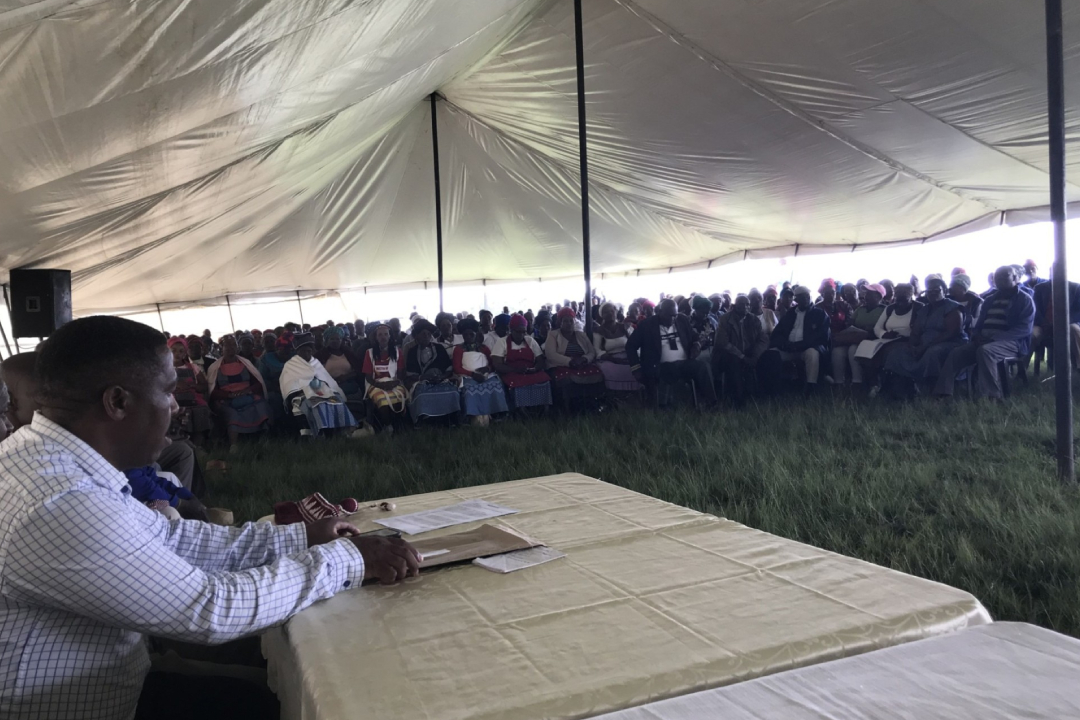
Honourable Mr Matamela Cyril Ramaphosa Tuynhuys Building Parliament Street CAPE TOWN 8000 Dear Honourable, Ramaphosa REQUEST FOR YOUR URGENT INTERVENTION: EASTERN CAPE RURAL SMALL FARMERS’ STOCK THEFT Responding to an official invitation by Masifunisane Community Organisation, which is a voluntary association of small-scale rural livestock farmers, to meet with their leaders and members on Sunday, the 24th of February 2019, in Elliotdale. Present in the meeting were rural livestock farmers from Elliotdale, Libode, Mthatha, Willowvale, Idutywa, and Mqanduli. Masifunisane was established as a response to, a rampant scourge of stock theft in the affected areas. Working with local authorities, they are trying their best to track and ensure the return of all the livestock that has been stolen or gone missing. Unfortunately, their experience of success is rather disappointing for the following key reasons, amongst others: • Some of the Mqa nduli police and stock theft unit, are allegedly working with the suspects of stock theft. For instance, the organisation claims to have met with the Deputy Commissioner, Captain Swarts, Captain Monwabisi Mtirara and Captain Mchamba – the head of the Mqanduli Police Station Stock Theft Unit. In which they have yet to constructively receive required cooperation. If this is true, then it is impeding and frustrating any attempts by the farmers to achieve the desired objectives of their organisation. To this end, further details on these allegations are with the leadership of Masifunisane. • The Provincial Authorities were alerted to this challenge but up to date they have dismally failed to make the required intervention and resolve the situation. It is common cause, that, given the astronomically high levels of unemployment and poverty, rural farmers rely on t heir livestock to feed their families, educate their children and in general improve their livelihood. The unabated continuation of the stock theft in these rural areas, threatens the very possibility of rural development and enjoyment of decent livelihood by the rural people. In this regard, I propose that the Honourable President makes an urgent intervention on behalf of the vulnerable rural farmers who have been dismally failed by the provincial authorities, from the highest office in the land. This intervention may include, but not limited to, the deployment of a team of senior police officers to the affected areas of the Eastern Cape, in order to: • Listen to the affected farmers; • Assess with their provincial counter-parts on the scale and scourge of this challenge; • Investigate for themselves on the scale of the problems in these affected areas in particular and the Eastern Cape province in general; • Investigate the role of the police services as well as the veracity of the allegations referred to above; and • Ensure the effectiveness of the Eastern Cape stock theft unit. For further information with regard to the specifics of the incidents of stock theft as well as the allegations against the Mqanduli police, kindly contact the leader of Masifunisane, Mr Zingisa Kula. I will be pleased to be advised on the developments in this matter. Yours in service of the people. Mr Bantu Holomisa, MP President of the United Democratic Movement