Admin

21 Oct, 2025
Gade hides behind matric exams as Eastern Cape education crumbles
Statement by Bulelani Bobotyane, Provincial Secretary of the UDM in the Eastern Cape The United Democratic Movement (UDM) in the Eastern Cape condemns the conduct of Eastern Cape Education MEC Fundile Gade, who attempted to postpone Parliamentary oversight visits under the pretext of matric examinations. This was not a scheduling conflict. It was a blatant attempt to dodge responsibility in the face of damning findings about the provincial department’s failures, including criticism from members of his own party. The Auditor-General has confirmed that the Eastern Cape Provincial Department of Education spent 99.9% of its budget yet achieved only 10% of its infrastructure targets. Even African National Congress (ANC) Members of Parliament were forced to admit that the situation is devastating and called for heads to roll. Instead of welcoming oversight and taking urgent corrective action, MEC Gade’s instinct was to evade scrutiny and hide behind the hard work of matriculants who deserve his full accountability, not excuses. The ANC’s provincial government is effectively pretending to fix education infrastructure while knowing the maths do not add up. Officials admit that the province needs R72 billion to clear its backlog within ten years, yet they budget only R1.8 billion a year. That is less than a quarter of what is required, and even those limited funds fail to deliver. Spending 99.9% of a budget while meeting only 10% of targets is not progress; it is the illusion of governance. If the provincial education department truly spends 99.9% of its budget, the people of this province deserve to know what it is being spent on. Where are the new classrooms, the repaired roofs, the functioning toilets and the rebuilt storm-damaged schools? How can so much money disappear into paperwork, travel and administration while learners sit under leaking prefabs and teachers work without electricity or proper sanitation? This is not a resource problem; it is a leadership and accountability crisis. The timing of the exams does not absolve MEC Gade from appearing before Parliament or explaining how billions have been spent with almost nothing to show for it. Leadership means facing the truth, not running from it. The province’s learners study in prefabricated classrooms, hundreds of schools remain closed or vandalised, and 427 schools still have pit latrine toilets. These are the real emergencies, not the Parliamentary calendar. The UDM in the Eastern Cape welcomes this decision and commends Parliament for standing firm in defence of accountability. Oversight is not a favour to the provincial executive; it is a constitutional duty. The time for excuses is over. The children of the Eastern Cape deserve leadership that works, not officials who hide behind exams and empty audits.
Admin
13 Jun, 2017
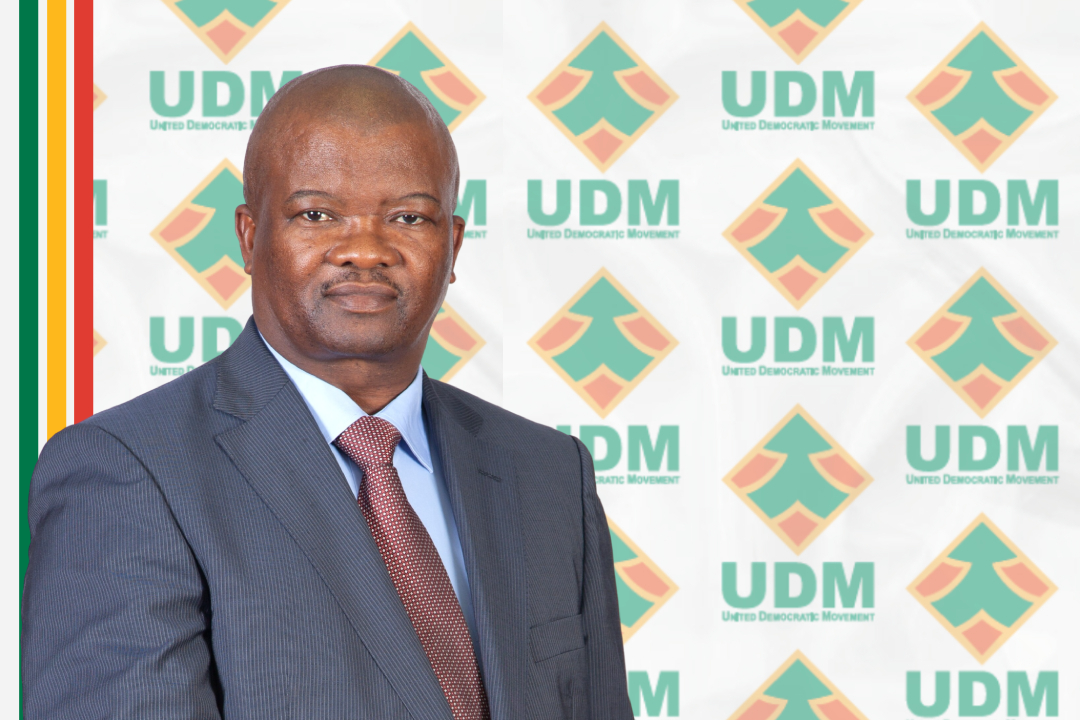
Condolences for Mr Ahmed Kathrada, Bantu Holomisa’s contribution to Parliamentary Debate
Honourable Speaker, and Honourable Members The United Democratic Movement (UDM) appreciates the opportunity to honour, Ahmed Kathrada, a tower of strength and a source of inspiration to many generations; even if it could have been done earlier and better. I had the honour to meet Kathy and his fellow Rivonia Trialists in Umtata in 1989. Their presence and words spoken at the welcome-home rally, we organised for them, gave us the courage to continue supporting the struggle for liberation, knowing that we were on the right side of history. During my encounters with this stalwart, and others, they showed courage, humility and dignity. They reminded us that the seeming impossible can be done. They were always attentive, frank and robust when discussing issues. Again in 1990, the Rivonia Trialists converged in Umtata to welcome home the late OR Tambo. At that time, in the company of the late Madiba and OR, we discussed our perspective on the so-called Black on Black violence. I was accompanied by the current Military Ombudsman, General TT Matanzima and the current Commander of the United Nations Forces in the Democratic Republic of Congo, General DM Mgwebi. We advised the leadership that the Apartheid government was negotiating in bad faith and that it was trying to catch the African National Congress (ANC) with a Trojan-Horse strategy. At that time, it became clear that the National Party delegation (led by Mr Niel Barnard) and the ANC team (led by Mr Jacob Zuma) had failed to plan for the security of the leaders and activists. It was a big security risk that could have created serious problems for the success of the negotiations; we therefore stepped in. The rest, as they say, is history. Today, the UDM offers its condolences to Kathy’s wife and life-partner, Ms Barbara Hogan, the family, friends and the ANC. During his last days, Kathy was deeply troubled by the conduct of the sitting Head of State and could not reconcile this conduct with the sacrifice he and other stalwarts made for this democracy. I hope that this House will soon truly honour him by responding positively to his call to Mr Zuma to leave office; especially seen in the light of this most recent email scandal. May his soul rest in peace. I thank you. Address by Mr Bantu Holomisa, UDM President, MP in the National Assembly
Admin
30 May, 2017
Debate on Budget Vote 02 – Parliament by Mr Lennox Gaehler, MP
Honourable Chairperson and Members The Presiding Officers of this 5th Democratic Parliament, in the foreword of the Strategic Plan 2014-19, said, “Parliament exist to represent people and to ensure their involvement in government processes”. In this regard, and in the context of celebrating its twenty years of existence, we would recommend that this house, deliberately creates more mechanisms for citizens to have access to all the laws made by Parliament. We must move towards a deliberative participatory model of democracy anchored by an aggressive civic education. It is through knowledge that the people can understand and appreciate their responsibilities and rights in a democracy. Participation is an essential part of development; it develops self-confidence, pride, initiative, creativity, responsibility, cooperation and sharing and working together. Without meaningful participation development will lack and all development efforts and alleviation of poverty will be immensely difficult, if not impossible. People must be enabled to take charge of their lives and solve their problems whilst government and other development agencies are creating conducive environment and are facilitating. Secondly, the relationship between the parliamentary management and the staff has to be addressed with speed. It cannot be correct that each financial year we face possible labour action, because the management and the workers’ representatives are unable to dialogue effectively. The current dispute on salary increase and the alleged threat of retrenchments do not augur well for the effective functioning of this institution and has to be resolved with speed. Lastly, the outsourced function of cleaning, requires a reconsideration in order to safeguard jobs. The employees have proposed that they be insourced as Parliamentary staff. Given that their service is inherently part of the work of Parliament, we support the proposal for insourcing. We propose that the Presiding Officers prioritise the resolution of this matter. The United Democratic Movement supports the policy debate on Budget Vote 2. I thank you. Address by Mr LB Gaehler, MP in the UDM Eastern Cape Representative in the National Council of Provinces
Admin
27 Mar, 2017
The People’s Parliament must get its priorities right: Parliamentary oversight visits are not properly resourced
Letter written to the Speaker of the National Assembly, Ms Baleka Mbete, from Mr N Kwankwa, MP (UDM Chief Whip in the National Assembly) Dear Madam Speaker THE PEOPLE’S PARLIAMENT MUST GET ITS PRIORITIES RIGHT: PARLIAMENTARY OVERSIGHT VISITS ARE NOT PROPERLY RESOURCED This matter has reference. Last week, the Parliamentary Portfolio Committees on Public Enterprises and Cooperative Governance and Traditional Affairs, went to Johannesburg for an oversight visit. The visit pertained to the resolution of a conflict between Eskom and Soweto residents (particularly in Diepkloof, Orlando East and Soweto pensioners) regarding installation of prepaid meters in the area. We were on site for several days; arriving on Tuesday, 21 March staying until Friday, 24 March 2017. Our programme consisted of meeting sessions with the aggrieved community members, aged persons, from 10:00 to 16:30 – which means that we were continuously engaged for six and a half hours per day. Absolutely zero provision was made to ensure our basic comfort; there was not even a jug of water available. Madam Speaker, I am not talking about luxuries here! Just a simple thing, like keeping us hydrated during the course of our work, was seemingly too much to expect. On one occasion, the Members of Parliament went on a hunt, on foot, to find a decent eating establishment in a shopping mall; this was not a productive use of our time. On another occasion, I had slipped out (in the rain) of the consultation session to buy something to eat and drink, since I could no longer concentrate. I hurried to minimise the time spent outside that session. The only available shopping spot was a spaza shop, where the selection was so limited, I out of desperation, bought a packet of biscuits. As I slipped back with the open packet of biscuits, a queue of elderly people started to form in search of something to eat. I shared my meagre proviant, not only with them, but also with my colleagues (a packet of biscuits only went so far). The seniors complained bitterly. They asked what kind of Parliament, forces the elderly to engage with it, for hours at a time over several days, without any light refreshment, whilst we as representatives of Parliament, knew that they were elderly and that many suffered from diabetes. I, to my horror, later discovered that the packet of biscuits had expired. Having bought it at a spaza shop might explain that, but keep in mind that aside from eating them myself, I shared these biscuits with the pensioners and colleagues. The repercussions of possible food poising would have been devastating. In the end, should that have happened, it would have made me personally responsible for such a dire consequence. The whole situation was embarrassing for me as a Member of Parliament, because I was forced to leave a meeting, which was disrespectful, and could have led me to missing important information. It reflected badly on Parliament, and I certainly felt beleaguered. When I raised my dissatisfaction about the situation with the committees’ leadership, they explained that this situation arose because of budget cuts on oversight work. Madam Speaker, we are constantly reminded that Parliament must cut back on its expenses; and especially eliminate frivolous ones. The United Democratic Movement (UDM) wholeheartedly agrees with the instruction of National Treasury that we should tighten our belts, but I have two problems with what happened last week: 1) Providing water (at the very least) would not have broken the bank and it would have ensured a basic level of comfort for the Members of Parliament, as well as the elderly members of the public, during hours’ worth of consultation time with the affected communities. It requires sustenance and stamina to keep mentally engaged and physically able to do such work. 2) Secondly, any contention that there is no money to provide for, even the basics, is preposterous. This is because, as late as December last year, Parliament’s Secretary was defended on the official parliamentary Twitter account following an exposé in City Press that revealed Mr Gengezi Mgidlana spent over R40 000 on being chauffeur-driven in a Mercedes-Benz on a so-called study visit in Budapest in July 2016. We also read that an extra R1020 was incurred for a taxi trip to the airport. To add further insult, this was not the first time that his lavish travel style has been on South Africans’ dime. Earlier reports revealed that he, together with senior parliamentary staff, spent millions of Rands on so-called benchmarking trips last year. Flying business class and staying in five-star hotels in the United Kingdom and Turkey. While in London, we heard, Mr Mgidlana stayed in a R14 050-per-night (at that time, R42 150 for three nights) room at the luxurious Conrad London St James Hotel. In another instance, he had also incurred a bill of R52 638 for six nights at the Michelangelo Hotel in Sandton earlier in 2016. What makes matters worse, is your past condonation of this abuse of public money by the Parliamentary officials in question. Madame Speaker, it is clear that something is wrong with the running of Parliament’s business. How is it possible, never mind justifiable, that the Secretary of Parliament can literally blow millions of Rands, but a few thousand Rands can’t be made available to facilitate our work as public representatives. Lastly, as part of the cost saving measures, Members of Parliament had been told that we are provided with a subsistence and travel allowance and we should spend this money on sustenance during the day. That is all fine and well, but I had left work on Friday and was only refunded the food expenses I incurred that evening. This lackadaisical administrative approach creates concern about Parliament’s administration and its finances. Given the Secretary of Parliament’s (and other officials) reckless spending and clearly frivolous joy-rides, the call for us to tighten our belts rings hollow. Madam Speaker, Government does not have its priorities right. To my mind, it is clearly more important to ensure the quality of our work in service of the People’s Parliament (by providing at least some basic sustenance to Members of Parliament – as well as the public – on oversight visits) than having Parliament’s officials romping around the world in the most expensive way possible. The UDM calls on your office to review Parliament’s budget, especially the allocation of travel expenses to officials, as well as the allocation of resources to ensure that one of the core functions of Parliament, i.e. oversight visits, are adequately resourced to maximise the positive impact our work must have on the daily lives of South Africans. Yours sincerely Mr Nqabayomzi Kwankwa, MP UDM Chief Whip