
Admin

13 Aug, 2019
Eastern Cape Legislature: Mr Mncedisi Filtane, MPL’s contribution Vote 12: Treasury
1. Having tried to juxtapose the MEC‘s policy speech with his department’s operational plan driven by such a minute budget, I could only conclude that the Eastern Cape government is going nowhere. When you reduce, by as much as 25%, the budget of Treasury, what do you expect to achieve in the sickly fiscal environment? If the whole province projects a revenue of R6 billion but commits to just R1, 4 billion then psychologically, those tasked during operations with collecting the dream R6bn, will immediately drop their efforts by whopping 80%. Ndokhe ndibone xa kusenzeka umlingo. Poor fiscal management continues to kill our provinces political, social and economic dreams. One suspects that political instability within the ruling party plays a big role in the mismanagement of allocated funds, hence the recurrence of irregular wasteful and non- expenditure of budgets. 2. Treasury should incentivise and reward departments that show great strides in tight fiscal control. Not only had that but even challenge departments in the economic cluster to produce an X number of jobs for every X R3 spent. Treasury should actually have a special internal unit that focuses on two things: ? The constant link between departmental expenditure and jobs created and sustained. ? Fiscus spent which results in enterprise ownership by Eastern Cape citizens. The fiscus continues to be plundered by the people from outside the province. Our fiscus should be used to create equity for the citizens of this province. The development of the invoice-tracking mechanism is much appreciated. It cannot be that it is practically impossible to simply put a stop to civil servants who do business with the state. As things stand there are officials who make sure that their invoices are fast tracked for payment? Surely this can be stopped. We implore Treasury to ensure that there is consequence management for those who plunder state resources. The additional powers conferred on the Auditor General should be utilised not only to deter potential thieves but severely punish the devilish beneficiaries. 3. Despite the policy position declared by the National Minister of Finance that tax collection has to be increased, yet in the Eastern Cape the source and base of an increased tax revenue seems to have be given very shy attention. There are no bold steps within the Economic Cluster to increase the tax base. This assertion is based on the type of projected jobs. Labourers earn low wages; it is the middle and upper class as well as businesses that form a solid tax revenue base. The MEC for Finance in his budget speech puts that emphasis on infrastructure development and agricultural economy. We know the bulk of the infrastructure budget goes to contractors and the goods they procure. Less than 25% goes to professionals. So, we would need to make sure that both the supplies and contractors are locally based in order to drive that budget to local suppliers. Agriculture we all know that this sector contributes just around 2% to the GDP consequently its contribution to our tax base is understandably low. In order for it to improve its contribution to our tax base, the export market would need to be tapped into in, a big way at that. There you talking billions. Another potential revenue base is by creating, at municipal level, to an environment in which professionals like doctors’ consultants, teachers etc. would feel comfortable to live and work. But alas the conditions are just too atrocious in most of these municipalities. Hence the brain and fiscal emigration to other provinces, where there are better living conditions. 4. Did it occur to the executive of the Eastern Cape that you are sending a very negative message to investors, when you reduce the budget of such a strategic department by whole 25%? The UDM takes this opportunity to implore the powers that be to review this situation. Add to that the small change allocated to the department of economic development, then potential investors get a clear message of just, how not serious you are on the economy.
Admin
28 Jun, 2019
Response to the premier’s Eastern Cape SOPA on the 28th June 2019 delivered by the Honourable Mncedisi Filtane, UDM Member of the Eastern Cape Legislature
1. We would like to take this opportunity as the United Democratic Movement and formally congratulate you on your crowning as the Premier. However, William Shakespeare once scribed in Julius Caesar, if my memory serves me well: “Uneasy lies the head that wears the crown’’. You will be no exception to this notion. Let us dissect the beast you presented to us. 2. The route to solving most social challenges lies in an inclusive economy in which the majority of the Eastern Cape citizens wholesomely participate. There is a whole mile to meander in order to get there. Your speech hardly sounded like a starter’s gun. Consequently, we remain with more questions than answers, the reason being that you indicated the pointers but fell short of: • Telling us how to get there and, more importantly, • Exactly what fruits we shall harvest for our efforts, and when. No short-term, medium-term or long-term projections. You were generous with generality. Because of the dire situation engulfing the state of our economy, we expected a more radical approach to tackling the economic woes of the province. 3. Today’s policy buzzword in government corridors is a ‘’ transformed economy’’. Part of your preamble states that: “…we are here to outline our programme of action in the next five years’’. ‘That is why we expected more detail. 4. Some of the questions that arise are: (i) How much will preferred areas of investment contribute to the GDP of the province? (ii) How much ownership stake will be allocated to the previously disadvantaged to advance the cause of ownership? (iii) How much raw material, including for infrastructure development, will come from the Eastern Cape? Are you setting up factories for the manufacture of those materials? Here we wait to see an extension of the value chain, both vertically and horizontally. (iv) Exactly at what rate will your administration produce food within the province so that we greatly reduce the unhealthy importation of food? This is very sore point, Honourable Premier, when one considers the amount of land the Eastern Cape has. A lot of which is suitable for agricultural produce. How many will feed from 50,000 hectares? (v) You have listed tourism as one of your administration’s priorities, yet you have spent less than half a page talking about this sector. As a result, you have not addressed the very fundamentals of any economy, which is product development, referring only to the second last value step which is selling. “What will be sold, and produced by whom with what and where? The exception here is the waterfront in Port Elizabeth. (vi) Sport attracts lots of consumers yet you have said zero on it. Knowing that sport offers itself as a very viable option to intelligence driven economic opportunities, then we have to ask you why you did so much injustice to sport? Knowing that sport is also a catalyst for social cohesion, then why did you leave it out? This would have given the Eastern Cape citizens an opportunity to feel that those that want to make a living out of sport are foregrounded by the Mabuyane administration. You have missed out on a golden opportunity. The Eastern Cape has produced a number of rugby springboks, but the current administration has sent out a loud message saying “we care less about the legacy you have left behind. Mara why, why, why Honourable Premier. (vii) You painfully complain that it was the deliberate act of the apartheid regime not to invest in the economic infrastructure of our province to make us the labour basket of the country. But alas, all the proposed construction projects were neither for of specific employment numbers nor level of local ownership once in operation. If the focus of government remains anchored just on skills development only, then your administration will have created a perfect platform for prolonging the very apartheid strategy you rightly bemoaned, we want change. Change is what we want. Are you able to deliver drastic change? Siphendule Mhlekazi. (viii) So, you are planning to build a Smart City. Hmmm? Where are you going to get smart administrators and mayors from? When you allowed yourself to day-dream about a smart city, had you so soon forgotten about Mthatha’s rolling collapse with filthy streets, no water, no power and a recently sacked mayor of the ANC? Had you forgotten about the fact that most villages in Mnquma are accustomed to live without water, or were you actually dreaming about a “dark city” but because it was during the day you actually thought there was light in that city? (ix) Kha uqale ulungise I gravel road ezi zibulala imoto ezithutha abantu. (x) We welcome your admission of fifteen years of failure by three administrations, but now you want to pass the buck to civilians by establishing a Khawuleza Project Management Office within your office. Thereby sending a clear message to the current public servants to say ‘’I have no confidence in you’’, look I am superimposing another structure on you. Are these members any better qualified than your current staff compliment? (xi) One of the best ways if preparing a country for economic revival is to re-organise the fundamentals in the education sector. I just would not believe my own ears to hear you say that you want to equip children with skills that would make them highly competitive in the labour market. A flood of questions gushed to my mind as a seasoned development practitioner. (a) In whose forms will they be working? (b) Why not prepare them to be creators of wealth instead hewers of wood? (c) Why not prepare them to be knowledge producers, inventors, researchers, product creators in their own right? The list is long, but time is limited for me. (d) Why leave out men on projects? (e) The effect of climate change in development. (f) The fourth industrial revolution to be embraced with caution, there are too many unskilled citizens who must earn an income. It is already beginning to bite, estimated to take six million out of work. (g) Prevalent fraud in department like education. (h) Will you ensure the implementation of the amended Audit Act? (i) How many job submits must your administration organise in order for jobs to be actualised. Since 2005, this province has been holding these fruitless summits very regularly, but jobs dololo. Instead, more jobs were being shed by the previous economy. We suggest a different approach in fighting joblessness. (j) Your administration has virtually no local government as if the Auditor General’s report is anything to go by. I thank you
Admin
12 Apr, 2019
Bantu Holomisa speaks at a Unisa panel discussion on the 2019 general elections
• Our hosts today • Dr Somadoda Fikeni, our moderator • Those who represent the various departments that sponsored this panel discussion • My colleagues from other political parties • Academics and students • Ladies and gentlemen Thank you for affording me the opportunity to have a chat with you today. 1. The UDM’s road of success The United Democratic Movement (UDM) has since its inception batted on the wicket of the ethics of good governance. In fact, the UDM in part owes its beginning to that principled stance. My testimony at the Truth and Reconciliation Commission, about corruption in the former Transkei, got me unceremoniously kicked out of the African National Congress, because I refused to recant. Soon after that, the UDM was born and we have not stopped fighting for what is good and right in this world: • We opposed the immoral floor-crossing legislation that was eventually scrapped. • We succeeded in having the Independent Electoral Commission’s former Chief Electoral Officer, Pansy Tlakula, resign because of an irregular lease agreement she organised. • We were part of the legal action taken to preserve and protect the former Public Protector Thuli Madonsela’s report on state capture. • The UDM was the catalyst that saw coalitions form after the 2016 elections. • We did our part in forcing the former president to vacate his office, specifically taking the matter of the secret ballot to the Constitutional Court and organising one of the biggest marches to the Union Buildings. • The UDM were there with our colleagues from other opposition parties when we asked the Constitutional Court to order parliament to consider the former president’s conduct and whether he is impeachable. • We have asked President Ramaphosa to intervene in the malfunctioning and corruption-ridden SETAs. Nothing has yet been done about it, but we won’t give up. • Various communities will attest to the fact that the UDM has intervened on their behalf to have government, at municipal, provincial and national levels, attend to their service delivery complaints. • Most recently, the UDM exposed alleged corruption at the Public Investment Corporation amounting to billions of rands. This directly led to the establishment of the Mpati Commission of Inquiry at which I am sure you saw me testify. Once again at our post guarding against corruption. These are the actions of a party that is opposed to pervasive corruption, maladministration and malfeasance in government. 2. Fighting government corruption It is a sad reality that South Africans have become jaded when they talk about government corruption. There is too much of it and it’s demoralising our nation. They only sit up and listen when “things get serious”, as we see with the current commissions of inquiry. Things are indeed very serious with billions of Rands at play. For the UDM, integrity, commitment and hard work are required from everyone in government, as well as those in the private sector. No quarter shall be given to those who fail. Rewarding party loyalty is an evil, that should become a thing of the past. The best quality must be ensured in all appointments, so that merit, responsibility and integrity is guaranteed, and excellence is rewarded. Specifically, the UDM believes that special courts must be established to investigate and prosecute the corrupt in the public and private sector. Also, each province must have an independent anti-corruption task team to determine the depth of corruption and to immediately act. 3. Safety and security For the UDM, the long-term solution to crime and violence lies in our people committing to a concerted effort to reform our society, so that we do not simply address the symptoms, but also the root causes. Although there are a number of initiatives that the UDM would introduce to bring about safety and security, I wish to highlight two specific strategies for the purpose of today’s discussion. a) As far as we are concerned, the recruitment processes of the police, defence and intelligence services must be revamped. The aim of such a programme will be to allow communities to participate in keeping their environments safe and secure. Individuals who are interested in a career in law enforcement will be trained and assigned to serve their communities. This will allow for the monitoring of crime, the gathering of intelligence and combating lawlessness, whilst also creating much needed jobs. b) The coordination between the ministries of justice, police services, correctional services, defence and national intelligence must be stepped up. The UDM proposes that a crime prevention ministry be established to coordinate the work of these departments. Specific objectives and deadlines must be set for the departments to achieve their goals. 4. Free education • The UDM supports fee-free tertiary education for students from poor and working-class families. Such an expanded programme can be justified economically as free education is a strategic economic driver, because it is an investment by the state in the creation of a larger tax base in the long run. However, once implemented under a UDM government, students’ progress shall be monitored and managed as an investment. • We also think that the National Student Financial Aid Scheme (NFSAS) is a big flop. It is hamstrung by chronic maladministration, corruption and a jobs-for-pals leadership scheme. In addition, the way in which NSFAS is structured produces graduates who end up mired in debt. Because of our under-performing job market, they will remain indebted with no hope of repaying their loans. Of course, the biggest challenge at the other end of this education process is making sure that our graduates have jobs. 5. Job creation The UDM has always said that a massive initiative focussing on job creation through infrastructure maintenance and development is one of the routes to go. This planned sustainable development project must be driven through the department of public works, in collaboration with all other departments. Furthermore, the UDM’s response to the challenge of unemployment includes: • Identifying markets for small firms, through promoting domestic and foreign connections to adequately address both the supply and demand side of the economy. • Developing capacity in the areas of improved business and entrepreneurial skills. • Identifying loan and capital sources, as well as facilitating loans and investments in community businesses. • Investing in sector-based planning and implementation, including the creation of sector-specific banks to provide financial assistance to historically disadvantaged groups and individuals. 6. Xenophobia Xenophobia in South Africa is not a new thing and, as a matter of fact, it is getting worse by the day. There are multiple causes of xenophobia, but at the risk of over-simplifying the matter, the UDM is of the view that the root cause lies in the unregulated and unfair competition for the poor’s meagre resources. The dearth of jobs is, for instance, part of this dynamic and complex situation. On the one hand, undocumented immigrants are exploited, because they are desperate enough to work for low wages. And, on the other, there are no job opportunities for South Africans that pay a decent wage. To add to the complexity of the matter we have the issue of undocumented foreigners illegally occupying dwellings. The owners of such buildings, should be brought to book as they exploit undocumented immigrants and, by default, also deprive South Africans of safe havens. Like it or not, much of the blame is to be laid at government’s feet as the impact of its inadequate control over the arrival of illegal immigrants, and lack of resettlement mechanisms, are not addressed. A UDM government will handle illegal immigration in a humane and holistic manner, in line with our continental and international obligations. We also make a call on undocumented immigrants to come forward and be registered. Finally, we recognise that legal immigrants contribute immensely to our society and our economy. We are home to, for instance, some of the best educators and academics who impart knowledge and do important research and development. The UDM believes that xenophobia has no place in our society, but we must also be cognisant of our responsibilities to our own people. It is entirely possible for both these ambitions to work harmoniously. 7. An Economic Indaba with land at the apex of its work As we worked on establishing a new South Africa, land was placed on the backburner. Political emancipation was our primary goal at that time. Land, as a tool to achieve economic emancipation and make reparation, should have been addressed straight after liberation. Matters would look very different if the land issue had been addressed timeously. We certainly would have avoided the destructive tug-and-pull we now witness. When the National Assembly took a resolution on the expropriation of land without compensation, the UDM voted in favour of this resolution after it was amended. The UDM certainly did not vote for free-for-all land grabs and evictions. In this regard, the UDM has long promoted the view that the matter can only be effectively resolved at our proposed Economic Indaba, where all stakeholders can congregate to discuss South Africa’s macro economy, with land at the apex of the debate. There are a number of pertinent questions that should be answered before we make any rash decisions. Those are, amongst others, the following: • Who exactly (individuals, companies and/or government) will be affected and how? • How does food security and economic stability impact implementation i.e. does it prevent expropriation in specific circumstances, and what those would be? • How will government handle rapid urbanisation and an ever-increasing need to make land available in cities and the concomitant denuding of rural communities and local economies? • How will traditional leaders and rural communities be affected? • How will entities such as the Ingonyama Trust be impacted? 8. Closing With these few words I leave you and invite you to ask me any questions you wish me to answer. Thank you
Admin
07 Mar, 2019
UDM welcomes ATM’s youth Deputy President and his followers to the UDM in Johannesburg
• Our newly arrived young lions • Ladies and gentlemen 1. Welcome Today the United Democratic Movement (UDM) proudly accepts a group of young lions into the fold. Welcome! You will have to hit the ground running as elections are around the corner. As new members of the UDM you will be part of the drive to rid our country of one-party dominance. We have all witnessed how one-party dominance has brought South Africa to its knees. Corruption has permeated into all sectors of society. Recent revelations have verified that government monies have been channelled to the ruling party via front companies. In essence, the taxpayer has footed the bill for the ruling party to, amongst others, ferry people to its rallies. Bosasa CEO, Gavin Watson, does not fear arrest, because to arrest Watson is to arrest the ANC. Government institutions are led by ruling party deployees that are mandated to channel money to Luthuli House. We can abide by the fact that Nomvula Mokonyane and her ilk will never face the consequences of their actions, precisely because they are deployees of ruling party. 2. What does the UDM’s manifesto say about our youth It is a given that this country rests on the shoulders of young South Africans, yet they are side-lined from economic and other opportunities. But, there are other possibilities for the youth to be their own wealth creators. The UDM therefore subscribes to the belief that our youth should not only rely on the private sector or government to create job opportunities. This is why the UDM would implement the following policies once it is in government: • Identifying markets for small firms through promoting domestic and foreign connections to adequately address both the supply and demand side of the economy. • Developing capacity in the areas of improved business and entrepreneurial skills. • Identifying loan and capital sources, as well as facilitating loans and investments in community businesses. • Investing in sector-based planning and implementation, including the creation of sector-specific banks to provide financial assistance to young South Africans. Also, under a UDM government, funding will be made available for political parties represented in parliament to have leadership training programmes to teach our youth, amongst others, about their country, current affairs, the constitution, patriotism, human rights, the political landscape, a culture of ownership, as well as respect. 3. Your task as UDM members • When we leave here today, go to your communities and preach the gospel of the UDM. • Make people understand that we, as citizens, must save South Africa from the slippery slope of corruption. • Go from door-to-door and speak to our people of the new direction the UDM envisages for our country. • Explain to them that the UDM’s political philosophy is based on integrity, dignity and prosperity. Integrity amongst our ranks. Dignity for our people and, Prosperity for all South Africans. I thank you
Admin
16 Feb, 2019
Bantu Holomisa’s keynote address at the launch of the UDM’s manifesto
• Deputy President of the UDM; • UDM National Office Bearers; • Members of our National Executive Committee; • The party’s provincial leadership; • The Nelson Mandela Bay Executive Mayor and the people of this metro who are our hosts; • Members and supporters of the UDM; • Fellow South Africans; Introduction Good day to you all, including those who are watching from home; welcome to the unveiling of the United Democratic Movement’s (UDM) 2019 manifesto. As the UDM enters its third decade as a party, our message is clear: we are ready to lead and, we are ready to govern! Our manifesto is available for all to read, but I want to highlight a number of salient points. This election is all about trust. We have a president who pleads with you to trust him; and this despite his party. Why? Because he knows that his party – the ANC – is not worthy of your trust. We all know what damage it has done, be it to our economy, our safety, our education and health systems, and so the list goes on. How can it be trusted when it stood meekly by, as Jacob Zuma and his cronies looted the state and stole your hard-earned taxes and deprived you of economic opportunity. We now know the cost of state capture. Billions of Rand have been stolen and many state institutions and agencies have been weakened. As a direct result of state capture, for example, PRASA has been disabled. What that means, is that the railway system is disrupted. Notwithstanding the fact that billions of rands of tax-payers’ hard-earned cash are used to rescue the ailing railway system. In practical terms it is even harder for those people who are lucky enough to have jobs to get to work on time. To cite another example, Eskom also is a victim of state capture. As we speak, we are unsure whether this rally will complete its business. There is the likelihood of being visited by an uninvited guest, who brought darkness: load shedding. Small businesses, which are the backbone of our economy, are most affected and cannot run their enterprises, because of this uncertainty. This situation is diametrically opposed to what the ruling party has been telling South Africans. We were told that the change of leadership will bring efficiency. We were told that load shedding is a thing of the past and that the future is bright. Like PRASA, Eskom is no longer able to perform the public service it should. Eskom comes up with a new excuse from the already used ones, such as the shortage diesel and coal. Now we are told that the Hitachi and Chancellor House project i.e. the Medupi and Kusile power stations, which they built, are the reasons for this load shedding. As we all know, Chancellor House is the ANC’s front company and it is therefore prudent that the ruling party must take full responsibility for plunging South Africa into darkness. We all suffer as a result. This kind of institutionalised corruption must be exposed for what it is, without fear nor favour. So, I ask you: how can South Africans trust the ANC? The reason we now know more details about state capture, thus far, is because of the revelations at the Zondo Commission of Inquiry. The Zondo commission exists, because the Public Protector recommended that it be appointed; and the courts agreed. The rule of law prevailed, despite the onslaught of Zuma and his party. We went to the Constitutional Court with three other opposition parties and succeeded in having the Public Protector’s State Capture report published. We can be proud of the role we played in protecting the rule of law. The UDM’s track record speaks for itself, to mention but a few: • No-one will question that the UDM has consistently batted on the wicket of anti-corruption and the promotion of the ethics of good governance. We have always called a spade a spade, to the annoyance of many. • We fought the immoral floor-crossing legislation and were vindicated when it was eventually removed from the country’s statute books. • The UDM took the matter of the irregular lease agreement of the Independent Electoral Commission’s offices to the Public Protector, after which Advocate Tlakula was forced to resign. • Post 2016 Local Government Elections, the UDM was the catalyst in establishing coalition governments in several metropolitan municipalities. • We coordinated the biggest march to the Union Buildings, which called for the former president to vacate his office. • The UDM was at the lead when some opposition parties took the matter of the secret ballot on the no-confidence motion in the former president to the constitutional court. We succeeded in forcing the speaker of the national assembly to pronounce on how the balloting would take place. • Since 1999, the UDM has steadily campaigned to have party funding legislation put in place, which has recently been signed into law. • Most recently, the UDM exposed alleged corruption at the Public Investment Corporation amounting to billions of Rands. We called for the chief executive officer to pack his bags and leave, which has happened. We have further asked the president to institute a commission of inquiry, which he has done. • Various communities will attest to the fact that the UDM has intervened on their behalf to have government, at municipal, provincial and national levels, attend to their service delivery complaints. This has been our mission since the Mandela, the Mbeki, the Zuma and now the Ramaphosa administrations. • We have further written numerous letters to government to intervene in the malfunctioning SETAs, on behalf of the employees and needy pupils who are affected by the SETA’s inefficiency and corruption. This is part of our proud track-record of more than the twenty years – that we are a party stands up for what is right and is not afraid to speak the truth to power! We have defended the constitution and we will continue to do so. President Ramaphosa may be a decent man, but he is just one man. It is said that people must vote for the ANC in order to allow President Ramaphosa to continue in office. But there is no guarantee that the ANC will allow him to do so. There is nothing to stop the ANC from deciding to remove Ramaphosa just as they recalled Thabo Mbeki and replaced him with a person facing over 800 criminal charges. Today we hear noises from the ANC that the past nine years have been disastrous under the Zuma administration. Yet the current crew was the very one who said that he did nothing wrong. They even invented a slogan that read: “We have a good story to tell”. I ask the question again: CAN WE TRUST THEM, given that the same organisation was at pains to defend Zuma and was hellbent on discrediting the Public Protector and the judiciary. Had it not been for the insistence of opposition parties and some civil society organisations, Cyril Ramaphosa would not have occupied an office at the Union Buildings. We should not be lulled into thinking that the leopard has changed its spots. To prove that, it is the same organisation who has asked Zuma to campaign for them and thus continue to undermine the rule of law. The voters of this country will not have their intelligence insulted and take a risk to trust them again. They realise that the ANC is a damaged organisation riddled with deadly division, dangerously unstable, and unfit to lead our great country. That is why the president did not even mention his party once during the State of the Nation Address. Not once! He knows that the ANC is a liability. He wants to draw the spotlight of the election on him. But our electoral system means that you can’t have Ramaphosa without the ANC! Which makes the UDM’s suggestion that the president of the country should be directly elected by voters, as in other democracies. And so, my message is this: South Africa is not the ANC. And these days, nor can it be said that the ANC is South Africa. It has lost touch with ordinary South Africans. It has lost its moral compass. It has betrayed its history. It has betrayed South Africa. The misuse of resources permeates both the public and private sectors. Where government is concerned, this mismanagement pervades all three tiers of government. When the UDM comes to power, one of the first things we shall invest in is professionalizing the civil service in order to deliver quality services. The appointment of DGs will be the sole responsibility of the department of public services in consultation with the presidency to avoid the current situation where ministers appoint their friends and thus perpetuates corruption. Another area in which we will invest, is the training of the personnel of the bodies responsible for our safety and security i.e. the police, intelligence and military. Their state of readiness must always be guaranteed so that they may execute their mandate. The people of this country deserve better and they yearn for a better alternative. They deserve a party that will put them first. Allow me to talk about the economic needs of South Africa. South Africa has fast diminishing hopes of being able to respond to the triple threat of acute poverty, ever-rising unemployment and deepening inequality. The UDM’s manifesto puts the economic needs of people at the centre of its plan for government. South Africa needs an inspiring and shared economic vision of where we are going in the next ten to twenty years. Looking back, the Codesa negotiations only focused on political freedom and consequently economic policy formulation has been left to individual ministers to the detriment of the development of a comprehensive and coherent economic plan. This approach to policy formulation is not sustainable, because as soon as changes occur in government, a new administration tends to disown previously adopted policies. Yet, the same political party has sponsored those ever-changing policies. To compound matters, the tri-partite alliance’s differing stances on the economy further confuses policies with the National Development Plan being the white elephant in the room. Although we do not out of hand discard the current administration’s economic summits, the UDM strongly believes that a similar exercise as the Codesa talks needs to take place, but this time in the form of an Economic Indaba. This forum should gather to address the backlogs and imbalances of the past, and examine international precedents such as the European Recovery Programme of 1948, also known as the “Marshall Plan”. Closer to home, the Afrikaner government was deliberate in using state resources to successfully address Afrikaner poverty. Piecemeal conferences and summits will not do the job; it needs a concerted effort with all stakeholders gathered under one roof to hammer out South Africa’s macro-economic policy. Even the governing tri-partite alliance have differed fundamentally from each other. These differences have raised tensions at Nedlac level. This is one institution that needs to be completely overhauled, given that there are new strong unions in this country such as SAFTU. South Africa’s economic growth could be realised if we all work together and communicate one message to would-be investors, both local and abroad. Health care The quality of healthcare infrastructure and maintenance are often below standard. Hygiene at many clinics is at unacceptable levels and must be addressed immediately. It remains a sad fact that many South Africans must travel huge distances to the nearest clinic or hospital. Therefore, health infrastructure and services need to be provided closer to the poor. A UDM government will commit itself to healthcare that is linked to other social cluster portfolios, recognising the role of social welfare, water and sanitation, basic life skills and awareness to improve the basic health of the nation. Education One of the UDM’s main priorities is to invest resources in schools, where it is sorely needed. We can never advance as a nation if we do not educate our young. It is the most serious structural constraint that the economy faces. Hence, a UDM government will prioritise the building, fixing and upgrading of school infrastructure. A UDM government will also make additional funding available to ensure that every school has the required learning materials and resources, and ensure that it is delivered on time. There are major discrepancies at state schools when one talks resource spending and infrastructure. Some have the necessary tools to fulfil their obligations to our children and others lack even the bare necessities. President Ramaphosa announced that advanced technology would be used to enhance teaching, but one cannot imagine a situation where a child works with a tablet at a mud school, who has no electricity to even charge the battery. We will establish a permanent commission on education whose primary responsibilities will be to establish and build upon basic educational policy pillars as well as ensuring that there is stability in the curriculum to give our learners the best opportunity to succeed in their studies. The UDM will reopen teacher training colleges and impose national standards for teachers and ensure that they have the necessary resources to provide the highest level of professionalism possible. School inspectors will be brought back to deal with erratic attendance by pupils, teacher laziness and to ensure that the administrative tasks are attended to. Safety and security The safety and security of our country and her people leave much to be desired. The criminal justice system has collapsed. When we hear about the information revealed in, for instance, the Zondo commission, one wonders if our security bodies are fast asleep as this happened under their watch. Under a UDM government, it will take steps to professionalise the criminal justice system. We will also lobby SADC countries to seriously consider establishing an apparatus to respond to cross-border-crime and terrorism, as well as the gathering of intelligence. Public transport There is an over-reliance, coupled with lack of maintenance of our road infrastructure, which has led to its rapid decay. A UDM government will return the units which used to maintain our roads, and not solely to rely on the current tender system that poorly pays EWP employees. A UDM government will further explore the possibility of having an intercity highspeed rail put in place, which could present the nation with the following advantages: a) The reduction of accidents and fatalities on our roads. b) Greater access to specialised services, e.g. courts, legislatures, hospitals and healthcare specialists, universities, etc. c) Roads that are taxed less by heavy vehicles that damage road surfaces which in turn cost a lot of money to maintain. d) The reduced dependence on road transport will have the spin-off of speeding up our economy. Such a profound transformation of our public transport system would be possible via the refurbishment and adaptation of existing railway lines and building additional capacity where needed. Specific UDM proposals Our manifesto is comprehensive and covers other areas that are important for a dignified and prosperous life, but I want to focus on a few areas where we offer distinctive approaches: Job creation The unemployment crisis in South Africa has many causes that underscore the need for a comprehensive strategy. As one solution, a UDM government will launch a massive initiative focussing on job creation through infrastructure maintenance and development. There is a big chunk of unskilled labour which could be absorbed in working in such programmes. They could, for instance, work on the upkeep of government buildings, construction and maintenance of dams and cleaning silted rivers. They could also be tasked to play a meaningful role in restoring eco-systems and biodiversity by fencing off land for agrarian and grazing purposes. Others could be skilled to take care of waste management. The UDM also believes that, for the development of the South African and African economies, it makes sense to gradually cease the mass export of raw materials so that jobs are created locally through homegrown processing and manufacturing. There must be a paradigm shift in the way that we think of job creation and focus on the empowerment of our youth to be wealth creators, future employers, manufacturers and business owners. In order to achieve this, the UDM will do the following: • Establish a distinct national fund, to assist frustrated entrepreneurs in getting the basic tools to start their businesses. • Invest in sector-based planning and implementation, including the creation of sector-specific banks to provide financial assistance to historically disadvantaged groups and individuals. Such sector banks could assist the youth to start their own business in, for instance, the textile, IT, tourism, hospitality, agriculture industries. Billions of rands are wasted on SETAs, whilst they could be transformed into such sector banks. • Remove the bottlenecks on the registration of companies by introducing an online application system to expedite registration. • Identify markets for small firms through promoting domestic and foreign connections to adequately address both supply and demand. • Embark on massive training programme of entrepreneurs to build and manage their companies. • Identify loan and capital sources, as well as facilitating loans and investments in community businesses. • Devote more resources to promote “buying South African” as a tool to stimulate local wealth generation and job creation. Land economy We support land reform and land redistribution – it is vital for our agrarian and rural economies, but also vital for restoring the dignity of our people, recognising the injustices of the past. But the issue is complex and must be understood as such: there are no easy answers and we must work to find consensus on a solution to benefit the landless. So, we need to build a strong, resilient consensus about how to tackle it. In the proposed amendment of the constitution, government could be empowered so that it may expropriate land without compensation, but subject to the development of comprehensive legislation. Such legislation must answer the following: • Who exactly (individuals, companies and/or government) will be affected and how? • How does food security and economic stability impact implementation i.e. does it prevent expropriation in specific circumstances, and what those would be? • How will government handle rapid urbanisation and an ever-increasing need to make land available in cities which denudes rural communities and local economies? • How will traditional leaders and rural communities be affected? • How will entities such as traditional trusts be impacted? • What will be the effect on the land tenure system particularly in rural areas? • What would the position be on the sale of, in main, urban land to foreigners? • How will the issuing of title deeds be sped up so that entrepreneurs may use them as collateral to secure capital for start-ups? Sustainable development: the environment Protecting the environment and our national resources are often placed on the backburner since the consequences of abuse are not immediately appreciable. People find an issue such as the depletion of the ozone layer an abstract concept that does not directly affect them. Many South Africans do not concern themselves with the environment, because of the notion that “it’s someone else’s problem” and therefore do not take responsibility for their own actions. Climate change got just one meagre line in President Ramaphosa’s recent State of the Nation Address. That is a serious abrogation of responsibility. A UDM government will not make this mistake. It will take responsibility. It will join the dots between climate change and environmental degradation to poverty and human development and economic policy. For development, to be both just and sustainable, it must recognise the inter-connectedness of the environmental, social and economic dimension of the crisis we face. High levels of poverty contribute to the damage of our environment. For example, the need to stay warm in the winter is a primary goal for rural and township communities, whilst the negative impact of wood collection on the environment may not be understood. A UDM government will implement a “Marshall Plan” to save our natural heritage that shall identify, build and reward individuals, institutions and community-based organisations to rescue and conserve our environment. We will introduce “green battalions” to counter, amongst others, soil erosion, over-grazing, deforestation and to also protect biodiversity, especially in rural South Africa. This country has failed dismally to manage waste. It is worse in the townships, informal settlements, towns and rural areas. South Africa is a tourism mecca in her own right, and something must be done to address waste management. Under a UDM government, conservation and socio-economic development shall be linked by allowing communities to have sustainable access to the life-supporting and income-earning potential of nature reserves and conservation areas. The UDM believes that, through the implementation of bio-diversity programmes thousands of jobs can be created, because we believe that it is possible to generate jobs and business opportunities whilst being environmentally responsible. We will implement tax incentives to encourage the private sector to invest in the development of technologies for conservation and sustainable use of bio-diversity programmes. This sets us apart from all the other political parties in South Africa. We offer a realistic as well as visionary alternative approach to our sustainable development challenge. Hence, a UDM government will also roll out an information campaign to teach the uninformed of the impacts of their actions on the environment and why it matters to their future prosperity as individuals and as communities. What is noticeable in all the towns and cities is that you hardly see trucks collecting garbage, and residents just find an empty space to dump their waste. A UDM government will embark on a country-wide clean-up campaign. We will provide the necessary tools to keep our country clean and, in the process, create jobs, as well as opportunities for small businesses to flourish. We will consolidate the massive number of environmental laws and regulations into one concise and effective law. Once in power, a UDM government will be active in the enforcement of environmental law with individuals or organisations that contravene it to suffer severe penalties. Budgets should be adjusted to make waste management a primary goal. The UDM’s position on coalition government I also want to touch on the issue of possible coalition governments after this year’s elections. If it should deliver no outright winner, as forecast by political analysts, the question of coalitions arises. In this regard, the UDM is of the view that any coalition government should be regulated so that the principle of serving the people is not suppressed by wanton political intimidation and playing the numbers-game that typifies the present local government dispensation. Hence it is important that coalition partners iron out their relationships directly after elections and publish their compacts so that voters clearly understand how that coalition will work and to have a set of standards to measure any coalition government’s performance. Role of faith-based organisations Religious values and practices are deeply entwined in the fabric of our daily lives, which means that faith-based organisations play a very important role in providing moral leadership and guidance. We, as a nation, have lost our moral compass as is evidenced by the crime and corruption that have become a permanent feature of our lives. During the apartheid years, the work of faith-based organisations formed a vital part of overthrowing that discriminatory regime. It could however be argued that, in the South Africa of today, they play a less critical part in leading our people on the path of decency, honesty and goodness. The UDM therefore calls on all faith-based organisations to again be the voice of reason for a nation in moral dire straits. Closure It is not rocket science to see that the gap between the haves and the have-nots is rapidly widening. As South Africans we need to address the backlogs and imbalances of the past. Our policies must be in line with our constitution which seeks to improve the quality of life for all South Africans. Once this has happened the gap between black and white. This is the consistent, principled approach to politics and policy that the UDM offers. We are ready to lead, and we are ready to govern! We offer a political home for all South Africans, united in the spirit of South Africanism by our common passion for our country, mobilising the creative power inherent in our rich diversity, towards our transformation into a prosperous and winning nation. The UDM has demonstrated integrity amongst all our members and leadership. Our three guiding pillars, integrity, dignity and prosperity, feed our minds and our actions as a modern political party that firmly stands against corruption and the exploitation of South Africans; especially the poor who cannot weather the effects of the ruling party’s dishonest, bungling government and don’t care attitude. For the past two decades the UDM has left no stone unturned in our fight to have corruption eradicated wherever we found it. We will continue that fight by ensuring effective procedures and establishing special courts and implemented to investigate and prosecute those in the public and private sector involved in corruption. We will continue that fight. And we will not rest until the dignity of our people is restored and everyone has the opportunity to live a prosperous and flourishing life. Thank you.
Admin
12 Feb, 2019
The UDM’s reaction to #SONA2019
• Honourable Speaker and chairperson of the NCOP • Mister President • Honourable Members South Africa needs key interventions in order to eradicate poverty, place more citizens in jobs, in particular young people, whilst closing the gap between the haves and the have nots. Firstly, we need massive investment in the maintenance and development of a well-coordinated and integrated socio-economic infrastructure that is driven by government. Reading the City Press report recently on the state of the Mahikeng’s socio-economic infrastructure is further confirmation that the country cannot wait for another year without this massive investment into the infrastructure development. Mr President, we invite you to visit places like Ikhwezi township, Norwood and Northcrest suburbs in Mthatha, to witness the reality of a road infrastructure that is non-existent. Like in many other parts of the country, these potholes have caused damage to private property such as motor vehicles. This is not only limited to the infrastructure that does not exist, but it includes that which has been upgraded but not maintained properly. A classic example of this is the Mthatha airport which was upgraded in 2013, yet it had to be closed due to poor maintenance. Instead of correcting this anomaly, government is busy fighting with itself on the so-called authority and responsibility. I have no expectation of any leadership to be provided by the current serving Minister of Transport given that in November 2018, he was made aware about this but he ignored the warnings. For that reason, I suggest that you ask the South African Air Force (SAAF) who have specialists on Aviation to assist with the Mthatha Airport whilst we are waiting for the sleeping Minister. This Aviation intervention is urgent Mr President, because the ongoing closure of that Airport is negatively affecting the economy of that part of the country. Many projects announced and started by this government are never get finished. There was a project to connect water from Mthatha Dam to the surrounding villages up to Coffee Bay. This project was stopped for almost three -and-half years, and we are told that there is no money to complete the project. What happened Mr President, is it this lack of proper planning or another day of looting. In a village near Burgersfort, in Limpopo, more than 72 RDP houses have been left unfinished since 2014. This is the same municipality that is alleged to have illegally deposited R200 million into the VBS Bank which has since been found to be a source of funding bottomless pockets of politicians from the ruling party. Again, another example of daylight looting from the poor. Mr President, the challenges facing the higher education sector are to governing party’s lack of proper planning for the roll out of fee free higher education in South Africa. This crisis management style of leadership has to be a thing of the past. In some health institutions instead of getting medication you are greeted and kept company by monkeys, this is the case at the Durban’s RK Khan Hospital. Despite the government’s knowledge of the infrastructure challenges in the health sector, there is no convincing strategy to address these problems. The current load shedding by Eskom is contrary to the pronouncement and commitments made by government recently. We were told, that load shedding is the thing of the past, yet Eskom is currently on stage three or four. Eskom comes up with a new excuse from the known diesel and coal. Now we are told that the project of Hitachi and Chancellor House in Medupi and Kusile which they built are the reasons for this load shedding. Chancellor House is the ANC fundraising front, it is therefore prudent that your party must take full responsibility for turning South Africa into darkness. It is also clear that the ever-increasing electricity tariffs are as a result of decisions of companies that are syphoning millions from the tax payers to the governing party. We welcome the reconfiguration of the intelligence service as it is a long overdue decision. It has been delayed because of the abuse of its mandate and resources. I thank you

Admin
01 Feb, 2019
UDM welcomes, Ms Sindi Mashinini-Maphumulo, former NFP deputy-president, to the fold
Address by Mr BH Holomisa, MP and UDM President in welcoming of new members to the United Democratic Movement on 1 February 2019 in Durban • Chairperson • UDM leadership, and • Most importantly, our guests; • Members of the UDM Your joining the United Democratic Movement (UDM) is a vital step to realise our dream for the socio-economic development of KwaZulu-Natal (KZN). As KZN has the second largest number of voters, this presents the best opportunity for the people of this province to shape their future through participation in the political environment, government and legislative processes. This province accurately reflects the socio-economic challenges our country faces today. On the 18th of January, thousands of unemployed nurses marched to the provincial department of health demanding jobs to fill the 40,000 vacancies in South Africa. To make matters worse, the eThekwini Municipality has fruitlessly and wastefully spent your money to the tune of no less than R29 million. On top of this, the same municipality has failed to take reasonable steps to prevent irregular expenditure that amounted to more than R700 million as the auditor general has found. We welcome you into the fold, and together we must immediately start work towards achieving the following goals: 1. Step-up the ongoing campaign to remove the looters who continue to steal from you through Bosasa, the Guptas, VBS Bank and others to come. 2. We must enter every door in this province and explain to the more than five million voters why they must vote UDM in the next election. 3. We must go out and create hope for the people of KZN and convince them that the UDM is the only party that can uplift them from the misery the governing thieves have dumped them into. 4. On 16 February, you will be in Port Elizabeth with your fellow members to launch the UDM manifesto. This is where we will together present the UDM’s solutions to South African problems. 5. Spread the word of the UDM manifesto and get people to watch the launch on television if they are unable attend. Let us make the 16th of February the UDM’s day for all households to come together and identify with the bright future we promote. The UDM has made a significant contribution in shaping the direction that the country should take, and with you joining these efforts, we can fulfil our dream of a winning nation. With you, we are certain of realising a country that is free from looters, thieves and corruption. You have made the right decision to be associated with a party that our first secretary general, Sifiso Nkabinde, who hailed from this beautiful green province, strongly believed in. You are creating hope for the nation; you represent the good that South Africa is. Thank you

Admin
28 Nov, 2018
Holomisa at the 5th RENAPRI stakeholder conference: speaking notes on Unlocking the economic potential of land through good governance
Speaking Notes by Mr BH Holomisa, (MP) and UDM President 5th RENAPRI STAKEHOLDER CONFERENCE: Unlocking the economic potential of land through good governance 28 – 29 November 2018, Zanzibar, Tanzania • Chairperson • Fellow panellists • Ladies and gentlemen 1. Land itself at the crux of the matter: the South African example As many of you will be aware, we in South Africa are in the middle of a heated national debate on land and the expropriation thereof without compensation. This debate is of course rooted in South Africa’s deeply divisive past; the reverberations of which we still feel today. Twenty-four years into our democracy and the emotions still run high on both sides i.e. those who held the land under colonial rule and the apartheid regime versus those who were deprived of their land sometimes using violence and/or abusing the law. I specifically launch from this point in my argument, precisely because having the conversation around the concepts of “land governance”, “economic transformation” and “agricultural transformation” is moot if one does not address property ownership and land tenure. Because those in South Africa who are debating the issue of land are pulling in opposite directions, it is clear that the matter of land ownership in my country will not be sorted out that easily. My political party, the United Democratic Movement, is of the view that the only way to find a meeting of the minds regarding land issues in South Africa, is for all stakeholders to gather under one roof and to have a constructive debate in order to find long lasting, sustainable solutions that will benefit all. In the end failure to resolve land issues increasingly becomes a barrier to achieving other development objectives, to fight poverty and inequality, and to promote sustainable inclusive growth. It is however true that the discourse on land in its manifestations is not merely about land as a physical item, but it is also about the reconstruction of society, inclusive economic growth and development, social development and power relations. 2. Land tenure and infrastructure development Land tenure and deeds of ownership is a key to giving people access to finance. This means that people are directly empowered to enter the formal finance and banking sector and obtain credit with their property serving as collateral. It is however vital to recognise that gaining access to land for collateral must first be preceded by infrastructure development or upgrading, since the lack or disrepair of infrastructure (especially in rural areas) negatively affects the value of the land. 3. Land tenure and rights under customary law and practice One example we will undoubtedly share, in terms of land tenure on the continent, is that much land is held under customary law and practice where land allocation and use are managed by customary traditions. Much of the agricultural activity in those areas is around subsistence farming, rather than having commercially viable enterprises that have higher productive profit-making farming, which will in turn create jobs and promote economic transformation in rural communities. Therefore, one of the primary concerns of any government should be rural revitalisation. For any individual emerging farmer, or a group of farmers, access to infrastructure and agricultural tools is vital. The creation of the necessary infrastructure will also generate jobs in rural communities and encourage the growth of more employment-creating agricultural-related enterprises. It is easy to see how these kinds of activities will incentivise rural communities to consider commercial farming over subsistence farming. 4. Land tenure; emerging versus commercial farmers In South Africa the disparity between emerging farmers and commercial farmers makes for a situation where the emerging farmer simply cannot compete with large scale farmers. The big farming concerns have easy access to financial resources and the tools of their trade. This will never change if the land tenure question is not addressed comprehensively. 5. Land tenure; the rights of women In particular, customary law and practices severely limit women’s rights to land and property. It has been argued that the agricultural sector in rural communities is underperforming in part because women, who are often a crucial resource in agriculture and the rural economy, face constraints that reduce their productivity. One of those constraints is land which means they tend to have less access to credit and insurance. However, many studies indicate that women would be able to achieve the same yields as men if they had equal access to land, production resources and services. In terms of government’s role in the matter, improving transformation, removing infrastructure constraints, and encouraging rural women’s participation in farmers’ organisations and cooperatives can help. 6. Tenure and government’s role • The sale of suitable state land to encourage local ownership for emerging and small commercial farmers to create jobs will enhance rural revitalisation. • A government must also make use of the opportunity where farmers are willing to sell their land to facilitate access for emerging farmers. • There is also an onus on government to acquire, or assist communities to acquire, land for development and agricultural enterprise. • Government must assist those accessing agricultural land in communal areas to make better productive use of their land. • Any government must have a comprehensive database for land use, planning and the efficient and sustainable use of agricultural resources throughout a country. The intention is to ensure that agricultural and other developments are sustainable and environmentally responsible, as well as ensuring that viable farmer settlement occurs. • Government must also ensure closer cooperation between its various departments involved in agricultural business. 7. Anticipating how the land issue will play out over the next 5 to 10 years I think that it will take longer than the next 5 to 10 years to make any long-term progress in settling the land issue in Sub-Saharan Africa. The wounds of the past are still fresh in many minds and to untangle the web that was spun during colonialism will take time. That said, I don’t think that it’s insurmountable, if enough pressure is brought to bear by communities, agriculturalists, non-profits, governments and conferences of this nature, changes will happen. Thank you
Admin
19 Oct, 2018
Speech by Mr BH Holomisa, MP and UDM President on the current political landscape, PIC corruption and post-2019 coalitions as a guest of the Current Media Forum
• Members of the Current Media Forum • Our host, Mr Peter Ford • Ladies and gentlemen 1. Thanks Before we go into the nitty gritty of our conversation, I want to thank the Current Media Forum and Peter Ford for inviting me to have this chat. 2. Introduction We certainly live in interesting times, even though much of the news we consume these days is nauseating. Waves of news about corruption and wrongdoing, both in the private and public sectors, break over our heads. However, if one takes a step backward for a moment, I think it is a good thing from the perspective that lancing a boil is better than letting it grow and fester until it explodes. Also, we must acknowledge the active role that the media, civil society and opposition parties play in exposing corruption. This is a sign that our constitutional democracy is functioning well, which is another bit of good news. 3. The waves of corruption: the PIC example At the risk of sounding like a pessimist, I want to paint a gloomy picture of the allegations of corruption at the Public Investment Corporation (PIC). Not only have the media done its work here, but the United Democratic Movement (UDM) played a role in exposing some of the alleged corruption. From our view point, the situation at the PIC makes the dishonesty and exploitation with Guptagate look like, if I can coin my own term, “Mickey Mouse Corruption”. Not only because billions of rands are involved, but also in terms of the wide web of “connected” people and entities implicated. At face value the “connected people” received preferential treatment in accessing vast amounts of money at the PIC. The practice of “facilitation fees” also seems to be one of the big bleeders. One of the others, for example, is the madness of investing in a dilapidated Mozambican oil refinery plant that is not operational, years after a massive cash injection from the PIC. Just as with the corrupt mess at the VBS Mutual Bank, there are hundreds of thousands of ordinary South Africans being ripped off and their financial futures are compromised. 3.1. Mpati Commission of Inquiry The UDM has welcomed the appointment of Justice Lex Mpati as the head of the commission of inquiry into the allegations of corruption at the PIC. We are of the view that the commission’s terms of reference are wide enough to give Justice Mpati and his two colleagues a lot to chew on. We do however hope that this commission is different to those we have had in the past where they take longer than expected to conclude their business. The deadline President Ramaphosa has given them must be stuck to; come hell or highwater. 4. State of politics in South Africa The good old days of the “new” South Africa has rapidly faded away during the past few years. At least the light at the end of a very long tunnel started showing with the election of President Ramaphosa, a leader who appears to be palatable to most South Africans. Although we have seen some of the positive actions from his office we must be realistic. Two decades of damage done by his ruling party, cannot be reversed in a few months, no matter who is at the helm. Also, given the infighting in the ruling party and that it will possibly not win an outright majority in 2019, there is absolutely no guarantee that Mr Ramaphosa, or any of the key cabinet ministers, will return to office. In fact, we might even have a mixed cabinet, should a coalition government be formed. Time will tell what President Ramaphosa’s legacy will be, but we can safely say that, at the heart of it all, there has been a leadership crisis. We do not have sound leadership in government to articulate the interests of South Africans as a Nation. Officially, we have thirteen political players in the field, based on the dictates of the electorate in 2014. We however have what one might call “majoritarianism” – that a Society is made to believe that there are only three players in the field. I am yet to read a newspaper covering the Nelson Mandela Bay Municipality that refers to it as a “UDM-led municipality”. I even forget that Ekurhuleni has a coalition government, because it is always referred to as an African National Congress (ANC) municipality. All the other metros where the Democratic Alliance (DA) governs, through coalition, are referred to as “DA municipalities”. Frankly put they don’t even attempt to say “DA-led municipalities”. In our view, quality has been replaced by numeric definition. In essence, we wish that media would spend more appreciation to other parties in the effort to promote a multi-party democracy. It is notable, that at face value, the only parties which seem to be stable or more free of scandals are the so-called small parties. Looking deeper into the public discourse, these so-called large/big parties are consumed by internal and external conflicts. 5. Possible coalitions come 2019 Like all other “interesting times” there are so many variables which makes it rather difficult to read the political landscape of South Africa to make any predictions. However, there seems to be emerging consensus that there will be no outright winner of the 2019 national and provincial elections. This must not be read as a negative but rather as a positive outcome of a flourishing democracy. This outcome would promote checks and balances that are needed in South Africa, given the current corruption that we are experiencing due to the current one party dominance in both national, provincial and local governments spheres. Of course, the phenomenon of coalition governments in South Africa is not new. The first democratic government post-1994 was indeed an example of coalition government i.e. the Government of National Unity (GNU). The difference between the GNU and all coalitions thereafter is that it had been regulated, whilst all others had no regulatory mechanism and were therefore managed “loosely”. Therefore, using the GNU example, future coalition governments must be regulated along the lines of the 1993 Constitution. Given the experience gained, as well as learning from other countries where coalition governments flourish, we can agree on a practical, and regulated system of governance. The UDM will not tolerate any coalitions that will allow it to be bullied or swallowed up by larger parties, who think they have the outright governing rights. A party who attempts to bully and swallow, the parties they are in coalition with, clearly shows their unwillingness to respect basic principles of democracy. 6. Closure As people interested in the future of South Africa, the matters that I have mentioned, amongst many others, occupy our minds. We try to predict what the political dispensation will be post-2019 and onwards and, as I have said, the factors that impact on our future change daily and we must realise that this is an open game. We will all anxiously watch the scoreboard to see what happens in the next six or seven months.
Admin
06 Sep, 2018
Parliamentary debate on UDM motion: working towards an integrated and comprehensive infrastructure development strategy to fight poverty, inequality, unemployment and underdevelopment
1. Introduction South Africa (SA), like many other so-called developing nations, faces challenges of chronic underdevelopment and/or development skewed towards urban areas, albeit in an unequal manner. Even urban development is fraught with inequality, as some provinces are in a position to deliver better infrastructure, while others trail behind owing to fiscal constraints determined by the income levels of their households. Yes, some progress has been made since 1994 to provide services and infrastructure in areas where it was taboo to do so in the apartheid years. However, it is simply not sufficient or sustainable, and some of it not built well enough and is out of date with modern innovations. SA has been in economic stagnation for more than a decade now, but mostly due to sluggish investment, poor governance and chronic corruption. We have experienced two quarters of negative growth this year, thus the current technical recession. Mister Deputy Speaker, if we were to unite around this new approach on infrastructure development in our country, we shall be in practice, marching united towards drastically reducing inequality, the eradication of poverty and unemployment. 2. The UDM’s approach to Infrastructure Development The UDM believes in a policy of intervention by the state in the economy through planned sustainable development programmes, which create jobs on a large scale whilst developing and maintaining infrastructure. There is, however, a serious lack of capacity, uniformity in spatial planning and infrastructure development between municipal, provincial and national governments. The introduction of mega infrastructure should not be done at the expense of the development of rural areas, townships and informal settlements. Mega infrastructure must be linked and inclusive of these areas for their benefit. In this regard, the United Democratic Movement (UDM), with its integrated policy approach, proposes that the work of the Presidential Infrastructure Co-ordinating Commission (PICC), must be locally driven from grassroots level. For instance, we need to have a comprehensive ward / municipal / district and provincial based infrastructure plan that will be coordinated at a central level by the PICC. We need to build internal capacity to restrict unnecessary dependence on outsourcing. The PICC must be able to ensure that the state has the necessary capacity at local levels. Government needs to plan infrastructure beforehand and ensure that their investment in education aligns with the infrastructure development goals to avoid having this sector being dominated by foreign experts. The PICC could also be tasked to ensure uniformity of infrastructure development across provinces; as guided by their individual needs. In so doing one province will not be favoured over another. For instance, primary schools across all provinces must have equal access to computer and science laboratories. Each worker should have the same access to transport to get them to and from work. Each citizen living in a rural area should have the same opportunity to benefit from the infrastructure and public services made available in urban hubs, as far as reasonably possible. South Africa is currently engaged in the land debate and the PICC could play a pivotal role in the implementation and monitoring of a future land dispensation, which includes the necessary infrastructure development. We cannot offer citizens access to the land that they desperately need and deserve, without in turn providing them with the infrastructure that they need to maximise that potential. For the PICC to succeed, the UDM suggests that we draw on the invaluable expertise that South Africans possess in all sectors. 3. Investment on Social Transport Infrastructure Our public transport system leaves much to be desired and an over-reliance coupled with lack of maintenance on our road infrastructure has led to its rapid decay. Government must do more and the UDM wishes to propose intercity high-speed rail. This is possible via the refurbishment and adaptation of existing railway lines and building additional capacity where needed. It is said that all roads lead to the proverbial Rome. But in South Africa maybe all roads and rails should lead to Gauteng and other hubs, to provide an alternative for South Africans, from the four corners of our country, to travel to and from our economic centres in a safe, affordable and speedy way. A high-speed railway system would, amongst others, have the following advantages: a) The reduction of people dying in road accidents at a high rate. This is unacceptable, and a high-speed rail system would reduce accidents and fatalities on our roads. b) Greater access to specialised services, for example courts, legislatures, hospitals with medical specialists and universities etc., will be more accessible. c) Our roads will be taxed less by heavy vehicles that damage road surfaces. d) Most importantly, the reduced dependence on road transport will have the spin-off of speeding up our economy, for example: • Businesses could be located anywhere and transport their goods with ease and at a relatively low cost. Our citizens will not have to face a choice between pursuing their careers and moving away from their families and loved-ones; • Businesses could employ people from far reaching places, thus spreading wealth to rural areas. • New business opportunities can be identified where it was previously deemed too remote. • Our lucrative tourism industry could be further unlocked, not only for international tourism, but also local tourism. Of course, such development costs money. However, in our case, it is not necessarily a lack of money, private sector has the resources we need but are reluctant to invest in corruption. Even public sector, for instance, the pension funds, can be best used to fund this new approach to infrastructure development. 4. Infrastructure development as an investment in our environment It would be irrational to disagree that, a new approach to infrastructure development must place a high value in our environment. This is especially applicable when considering our pristine natural resources. Furthermore, any infrastructure development must be done in consultation with affected communities. For instance, as part of a rural infrastructure development programme, communities should identify which areas should be used for grazing and planting, and which should be left fallow. Government must then take responsibility for fencing off land which will in turn generate local jobs. Lastly, 28% of Southern Africa’s water flows unused through the Eastern Cape rivers. Using this water effectively and responsibly could generate jobs in the short and long term. Also, some of the richest agricultural soil in the country lies uncultivated in this province. The refurbishment and establishment of irrigation schemes will not only create jobs and wealth, but it will also contribute to food security in the area and the country at large. 5. Conclusion We need to ensure that our infrastructure is advancing industrialisation, environmental preservation and social cohesion. In more ways than one, we need to ensure that South Africa and South Africans are no longer left behind but at the helm of their developmental trajectory. Thank you

Admin
16 Aug, 2018
Message by Mr BH Holomisa, MP and UDM President on the 16th of August 2018 at the Commemoration of the Marikana Massacre
• Programme Director • The families of the victims of the Marikana Massacre • Ladies and Gentlemen 1. Opening Thank you for allowing me to share in this occasion, the commemoration of the Marikana Massacre. We must always remember what happened on this awful day six years ago, so that it may never be repeated. 2. No consequences for criminals We live in a country where there are no consequences for breaking the law. Worst still when it is our very own government that is doing so. It is frustrating that there are no consequences for those who steal; there are no consequences for those who engage in corruption and there are no consequences for those guilty of murder. This must stop. 3. The UDM’s message to mineworkers It is the mineworkers of this country that must bring about change in how government manages the mineworking industry. Each time there is a cabinet reshuffle the policies change as a new personality takes over the reins. The mining experts are frustrated, because they are being tossed around by politicians. This too must stop. It is time for the owners and the mineworkers to get their acts together and speak the same language on this score. 4. Land and the purpose of the parliamentary committee’s hearings Whilst I have the opportunity, I want to remind you that the parliamentary hearings that took place all over the country, were to determine whether the constitution should in fact be amended or not. This is phase one. The second phase is where the “how” part should be discussed, whether the parliamentary committee recommends that the constitution should be amended or not. The current land-owners such as government, big business, the Anglo’s of this world and the traditional leaders and churches should meet under one roof, together with political parties, to hammer out the “how” part of such a process. People’s expectations have been raised and phase 2 must happen very soon, as there has already been threats of land grabs and even civil war. 5. When will things change? What each of us must take to heart is that things will not change unless we take to task those who have disappointed us… those who have abandoned us. We must stop moaning and do something about those who squander and pillage state resources. It is time for the South African voters to say: NO MORE. We will no longer be fooled by your empty election promises. The ANC must be punished come the 2019 elections. Their support should be drastically cut back as a lesson to any party which thinks it can walk over South Africans. That power lies in the voters’ hands alone; it lies in your hands alone. 6. Closing As I close, I say to the families of those who lost their lives, as well as to those who survived that fateful day; We will keep you in our prayers. We hope that time heals some of your sorrows and that peace will replace some of your heartache. Thank You
Admin
28 Jul, 2018
Bantu Holomisa’s address at the EFF’s 5th birthday
Address by Mr BH Holomisa, MP and UDM President On the occasion of the Economic Freedom Fighters’ 5th anniversary at Mdantsane Stadium • Programme Director; • The Commander in Chief of the Economic Freedom Fighters Mr Julius Malema; • The Deputy Commander in Chief Mr Floyd Shivambu; • The EFF Chairperson, Advocate Dali Mpofu • The entire National Command Leadership of the EFF; • The UDM chairperson in the Eastern Cape and member of the provincial legislature, Mr Tando Mpulu; • EFF members and the ground forces; • People of Mdantsane and the Eastern Cape 1. Happy birthday Let me start by saying: “Congratulations, Economic Freedom Fighters on your fifth birthday!” When the powers that be massacred the workers at Marikana in the North West, the United Democratic Movement (UDM) was one of the first political parties to visit this bereaved community. I there met the current leadership of the Economic Freedom Fighters (EFF) who still were with the African National Congress’ (ANC) Youth League. The rest of the events around this day are well documented. Fast forward to when the ANC booted out the executive of the Youth League and you decided to form a political party called the EFF. It is like yesterday when you called upon me to give a message of support on the formation of your party at Marikana. Since your arrival on the South African political scene things have dramatically changed. You certainly have made some waves and ruffled the establishment’s feathers. The EFF and the UDM worked together on several occasions where the convergence of ideas led to us collectively to achieve several victories in pursuit of South Africa becoming a winning nation; those include: • An unwavering fight against corruption, both in the public and private sectors; • The removal of the former chairperson of the Independent Electoral Commission after the Constitutional Court confirmed that she was conflicted; • The release of the State Capture Report which today is the subject of a judicial inquiry. • Going to the Constitutional Court where the judgement was made that the speaker of the national assembly had the power to decide that members may cast a secret ballot in the motion of no confidence in the former president of the country. • The call for the former president of the Republic to account and pay back the money stolen from the public. Our continued pressure bore fruit when he resigned. • There were several other high and constitutional court cases we won together, however, Zuma still owes us the money for the legal fees! Our team of legal eagles, under the leadership of your chairperson, senior counsel Dali Mpofu, has made us proud. For those who don’t know, I worked with Dali when he was part the campaign of release Mandela and other political prisoners. I also worked with him when we reburied King Sabata Dalindyebo. With his experience and knowledge of the South African politics, you were not wrong to bring him on board. The UDM and the EFF, together, organised several marches that culminated in the mother of all marches when thousands of South Africans walked to the Union Buildings to rid this country of a destructive, self-interested man who could not be trusted with this country’s future. 2. Coalitions post 2016 You heeded the call for us to start talking about coalition governments post the 2016 watershed municipal elections. Together with the EFF, the United Front and the Congress of the People, we agreed on the basic conditions for collaboration at our meeting at the Protea Hotel in Midrand. This collaboration effectively meant that the political landscapes in the big metros were going to drastically change. Hopefully this start in local government leads to bigger things since that exercise served as a game changer in the political landscape of this country. The voters of South Africa should not forget that we saved this country from the corrupt leaders of that time. They should give us the benefit of the doubt, as they cannot expect the ANC to correct itself. 3. The EFF’s agitation re the land question The EFF’s motion for expropriation of land without of compensation in the national assembly, which the UDM supported, has given rise to the current national consultations with the people. This is in line with the UDM’s call for an economic indaba, where the land issue would feature centre stage as one cannot achieve economic emancipation without security of tenure. The UDM agrees that there is a need to review the relevant constitutional provisions to ensure a fair distribution of land. It cannot be that the people who lived in the villages and townships of the former Ciskei and Transkei, and other homelands, find themselves still living in areas which were dubbed reserve areas for black blacks, whilst there are acres and acres of land now lay fallow and unused. As we follow the process on land we must come up with the laws, regulations and timeframes on how we are going to implement them. And, these must be followed to the letter. You will agree that this entire process is long overdue. There are however much to discuss, and I propose that those parties who voted in favour of the motion to convene a meeting so that we may compare notes and make sure that we sing from the same hymn book. We need to pay special attention on the “how” part of the process. The people’s wishes must always be at the heart of what we do, and we must ensure that the process is not sabotaged by those who want to bulldoze us because of a superiority of numbers. 4. Closing We must always ensure that rationality, supreme logic and the voice of the people are not only heard but that it dictates our course of action. Once more, Happy Birthday EFF and Thank you
Admin
16 May, 2018
2018 Budget Vote 10 – Public Service and Administration
Address by Mr ML Filtane, MP in the National Assembly Honourable Chairperson and members It is up to the citizens of South Africa to claim their entitlement to accountable government in which, constitutionally guaranteed human and other rights are upheld. The constitution alone, however sounds it is, is insufficient, unless it is fully applied in the daily lives of all of the people and the state institutions. The continued high unemployment rate, poverty and underdevelopment, demands that the more than 1.2 million men and women in the public service must double the effort in their daily responsibilities intended to create a better life for the people of the South Africa. Governance is about the implementation of laws and the actual provisions of services. Public Service and Administration programme actions should contribute towards an enhanced quality of life for all. At the root of many of the problems facing country at present, in particular that which relates to governance, is a lack of appreciation of the difference between party and state. The governing party’s cadre deployment policy is adversely affecting public service. Evidence is that the ANC cadre deployment strategy systematically places loyalty ahead of merit and competence. Therefore, it its own serious obstacle to efficient public service. Politically and factionally connected incompetent individuals are often deployed to public positions. This results in a demoralised public service. Incompetent and unqualified people are unable to deliver services efficiently and effectively. Competency and ethical standards are critical for an effective and efficient public service. In order to realise the public administration provided, read in section 195 of the Constitution, that renders services to all people in a manner which is impartial, fair, equitable and without bias, we need, amongst others: • To run public service as a professional state service; and • An integrated and seamless single public service across all the three spheres of government. A democratic public service must uphold values of honesty; integrity and non-partisanship; prudence in the use of taxpayers’ money. There must be faithfulness to the principles of fairness, impartiality and professionalism whilst carrying out their duties; with respect for the government of the day and most importantly – PUTTING THE CITIZENS FIRST. The ruling party has taken similar or same resolutions in many of its decision-making bodies, but, implementation, DOLOLO! There is no implementation because PATRONAGE and the ANC is in the same WhatsApp group. The governing party cannot operate without patronage and patronage is an antithesis of patriotism. So, with patronage, the people of South Africa will never be at the apex of the governing party programmes. That will only remain a paper commitment. Thank you
Admin
10 May, 2018
Local Government Week Outcomes: address by Mr LB Gaehler, MP (NCOP) in the National Assembly
Honourable Chairperson and Members Notwithstanding the recent outbreak of listeriosis, in which at least 190 people have died, South Africa does not meet the world health standards for food inspectors. According to the National Institute for Communicable Diseases (NICD), we have just one environmental health practitioner per 30, 000 people. The World Health Organisation (WHO) recommends a ratio of one environmental health practitioner for every 10, 000 people. This means South Africa does not have enough people checking the health and safety standards for production. Municipalities, in particular those in rural and small towns are the hardest hit. They must be helped to be proactive, to pre-plan and meet the required standards of at least one environmental health practitioner for every 10, 000 people. The NICD must have more laboratories to deal with this crisis. Chairperson, the municipalities are the culprits with regard to the non-payment of service providers within the regulated 30 days as per the National Treasury Instruction note number 34. This is not only a defiance of government policy, but a brutal onslaught against the poor masses of our people who are trying their best to live a better life, through their own initiative. Chairperson, we suggest that the NCOP institute an urgent investigation of the extent of this crime against our people who are running small businesses. We must know, which municipality is in debt to our poor people and how much is owned. Once that is established, culprits must be reported to the relevant authority for a proper recourse, on behalf of the local hawkers, caterers, B&B owners and many others. Lastly, there are still municipalities and institutions who are hell bent on defying another government policy, that of buying local. Officials go to places like Butterworth yet they sleep and eat in East London, they procure food and other items more than 50kms outside the local area. WHY ARE THE POOR MASSES IN RURAL AREAS BEING ATTACKED LIKE THIS. This new dawn must arrive to the poor too. Municipalities must play the ball and BUY LOCAL. Thank you
Admin
10 May, 2018
2018 Budget Vote 38: Human Settlements – address by Ms CN Majeke, MP in the National Assembly
Honourable Chairperson and members Outcome eight of the outcome-based performance approach that speaks to the mandate of the department adopted in January 2010, places responsibility on the part of the department to provide sustainable human settlements and improved quality living environment. However, visiting ward 28 in Soweto on Sea in the Nelson Mandela Bay Municipality (NMBM) where houses were built pre-2010, you will find a totally different and devastating reality. This has resulted in the community launching a petition with the Eastern Cape Provincial Legislature (ECPL). These citizens are currently registered and counted as beneficiaries of Reconstruction and Development Programme (RDP) houses by the human settlements department, yet, their situation can best be described as a glorifie squatter camp. In 2015, the NMBM human settlements department promised that the beneficiaries of the Zanemvula Priority Project would be temporarily removed to enable for the rectification programme to correct the defects. Three years later, these poor citizens continue to live with graves as their neighbours with absolutely no space or hope for economic, social activities and inclusion. For them, to bury their loved one, they have to rely on facilities outside from where they reside. Chairperson, many of the houses and settlements built between 1994 and 2010 are a far cry from the acceptable and current national policy, national norms and standards for housing and human settlements development. In ward 28, our people are crammed in overcrowded and dysfunctional spaces of less than 100 square meters with regular service interruptions. Chairperson, this department has to go back to basics. In this regard, we propose, that: • The department should assess all the houses and settlements that were built between 1994 and 2010, and compare it to the current policy, norms and standards. It must evaluate whether they are consistent with outcome eight, which provides for sustainable human settlements and improved quality of household life. • In the event of discrepancies, as is the case with ward 28, the minister must make policy proposals, consistent with the rectification programme and other relevant legal pre-scripts, to elaborate a plan that the department can and will implement to rectify the anomalies. • In this regard, the minister is invited to make ward 28 a pilot project. Accordingly, the minister should immediately contact the ECPL so that she may have access to the petition that carries the details of this challenge. • As part of attending to this national challenge, the minister, together with her provincial counterpart, should consider making an urgent visit to this ward to see for themselves the real circumstances defining our people in a democracy. Please Minister, consider joining the ECPL during their Public Participation Week on the 28 of May to the 1st of June in NMBM. Ward 28, is the epitome of a lack of broad national housing delivery goals, a lack of monitoring the financial and non-financial performance of provinces and municipalities. It also speaks to a lack of deliberate consultation with all the stakeholders in the housing delivery chain, including civil society and the private sector. Thank you
Admin
09 May, 2018
2018 Budget Vote 17: Social Development – Address by Ms CN Majeke, MP in the National Assembly
Subject for Discussion: Budget Vote 17: Social Development Honourable Speaker and members The United Democratic Movement (UDM) supports the report. However, the UDM feels that there are major obstacles in the way that the department must overcome, namely within social work graduates and the South African Social Security Agency (SASSA). Chairperson, drugs and alcohol abuse is one of the struggles that the country is facing. Parallel to this struggle is that thousands of social work graduates are trained at huge cost to state and are languishing at home and on the street corners of our villages and townships without work. In 2018, it is projected that the number of unemployed social workers will jump to 8 600 from 3 800. This increase is from the 4 840 social work students with government bursaries mainly from this very department. The UDM agrees with the chairperson of the portfolio committee that discontinuing the funding is not the solution and will create further crisis. South Africa has not enough social workers to drive the departmental community development agenda towards a caring and inclusive society as envisaged in the National Development Plan (NDP). We therefore propose that: • The department engages with other departments like correctional service to assess the need for this skill and channel the unemployed graduates accordingly. • Train the unemployed graduates in community development and ensure that the department drives this important programme with the requisite capacity. • Extend the community development programme to non-profit organisations and non-governmental organisation so that the proper utilisation of social workers is spread and that our communities are assisted to development consistent with the 2030 vision. The UDM is also angered by fact that SASSA officials deliberately misled beneficiaries and forced them to migrate from a cash payment system to an online system which create many complications for beneficiaries who are not familiar with online cash systems. Furthermore, the lack of understanding by some beneficiaries of online systems, leave them oblivious to unlawful deductions and corruption as seen in the past. SASSA must address the problems caused by those officials have deliberately misled the beneficiaries and must take the appropriate actions: 1. They must receive a suspension without pay for a period of no less than three months. 2. They must commit to do community service in that time to give back to a community they deliberately misled. 3. SASSA must make every effort to communicate the situation to those who are affected and revert the migration for those who wish to make use of the cash payment points. The UDM also recommends that government quickly creates a reliable, safe and fast system to pay out SASSA beneficiaries. Long queues and offline systems slow productivity of the country and need to be mended with the utmost urgency. The Chief Executive Officer of SASSA must fill the vacancies. The high vacancy rate places stress on the current employees and need to pick up the additional responsibilities and furthermore the vacancy rate will definitely hamper the performance of the office. Thank you
Admin
03 May, 2018
Debate: Condolence Motion on the passing of Ms Winnie Madikizela Mandela
Honourable Speaker and Members, Mr Nqabayomzi Kwankwa, MP and UDM Deputy-President A big tree, an outstanding servant of the people, a struggle icon has fallen. Dr Maya Angelou, in her poem “The Great Tree has Fallen” says, and I quote: “…. when great souls die, after a period, peace blooms, slowly and always irregularly. Spaces fill with a kind of soothing electric vibration. Our senses, restored never to be the same, whisper to us. They existed. They existed. We can be. Be and be better. For they existed.” As we mourn and are still trying to come to terms with the untimely death of Mam’ uWinnie, no one can deny the fact that our lives are better because she existed. Mama was a fearless freedom fighter, who brought her superlative courage to the struggle during the darkest hours of oppression. She was a colossus that bestrode the lives of the poor and downtrodden, shielding them from the vicious onslaught of the apartheid regime. It was therefore not surprising that South Africans, who understand the passage of the struggle for freedom, regarded her with veneration. It is because these South Africans understand that both in the war against the apartheid regime and in peace, Mam’ uWinnie served South Africa unfailingly and wholeheartedly for decades. For these reasons, it was also not surprising that, when Mama uWinnie passed away, the world rang with tributes to this great leader of our time. We were however flabbergasted by the ostentatious vulgarity of the criticism of her legacy by some of her detractors and the brazen lies they told to tarnish her image. Despite your venomous attacks on her, our love and respect for her remains undiminished. Disappointingly, even the behaviour displayed by some of those who tried to defend her legacy was at times marked by puerility. This group displayed an exclusivist notion to national interest and the right to defend her legacy, which was extremely intolerant of dissenting views, whether valid or not. It the saddest irony of history and a damning indictment of our leadership that we used her passing to divide the very same nation she fought tooth and nail to unite. Colleagues, you know that I prefer truth to comfort! Granted, Mama was not without faults. She made mistakes just like everyone else. However, to reduce her legacy to her mistakes understands neither the dangers of the struggle for freedom, nor the monumental sacrifices on which our pedestal of hope is premised. In this regard, we owe it to the youth of this country and future generations to tell an objective account of Mam’ uWinnie’s historical contribution to our liberation struggle that is free of distortions. Madam Speaker, Throughout our struggle for freedom, Mam’s uWinnie was sustained not only by her love for our people, but by her sincerity and commitment towards building a democratic, united, non-racial and non-sexist South Africa. In your honour Mama, we will continue to fight for the improvement of the lives of the poor and to ensure that land is returned back to our people. We will not let your passing, as our struggle icons, to be the end of era of South African greatness! We will continue to individually and collectively work hard towards building a South Africa in which we look forward to the sunrise of our tomorrow! Menze Thixo aphumle ngonaphakade. Umkhanyisele ngokhanyiso olungacimiyo. Thank you.
Admin
21 Mar, 2018
#HumanRightsDay Rally 2018, UDM Rally in Gauteng, DH Williams Grounds, Kathlehong, Ekurhuleni
Speaking notes for UDM President, Mr Bantu Holomisa 1. Welcome On behalf of the entire United Democratic Movement (UDM) leadership, I extend a word of welcome to all of you gathered here today as we commemorate Human Rights Day in South Africa. For each of you, being present is a personal sacrifice and is contribution to the life of the UDM. The UDM leadership therefore thanks you for investing your money, time and energy to be here, as we honour those who have come before us in the fight for a just and equal South African society; free of the shackles of Apartheid. 2. Remembering those who came before us Today, we remember the Sharpeville massacre of 1960 when police opened fire on thousands of people who protested the draconian pass laws. We will never forget that almost 300 lives were irrevocably changed that day; with 69 souls making the ultimate sacrifice so that we can, today, enjoy our civil liberties in a post-apartheid South Africa. The great tragedy of what happened that day, is that it was not the end of the struggle for the dignity and freedom of non-white South Africans. A few days later, on March the 31st, more than twenty people were massacred in a march against the pass laws in Langa, Cape Town. We had the Soweto Uprising – who will ever forget the iconic picture of the limp body of young Hector Pietersen? Much of which followed, happened in the name of the armed struggle, which affected black and white alike. Today, is also the 33rd commemoration of the 1985 Uitenhage Langa Massacre, where at least twenty people were killed at a Sharpeville commemoration. On this day, we also remember the 1992 Bhisho Massacre and the tragic deaths in Boipatong, where the fires of the so-called black-on-black violence were stoked for the most nefarious of goals. Soon Shell House followed. The word “massacre” far too often marks low-points in our history; and this does not even quantify the sacrifices that so many other black and white South Africans made, so that we may all enjoy political freedom. 3. What does Human Rights Day mean in 2018? Sadly, that awful word, again scarred our nation’s consciousness when we witnessed the Marikana massacre, which was the single most lethal use of force by South African security forces against civilians since 1960. Like at Sharpeville, many of the victims were shot in the back whilst trying to flee for their lives. We witnessed (what can arguably be considered as a massacre) when over a thousand patients were relocated to mainly unlicensed NGOs by order of the Gauteng Department of Health… 144 people lost their lives in this tragedy… and they were vulnerable people who most needed their human rights to be protected! It is therefore clear, that fighting for human rights (even when it is entrenched in our constitution), should remain on our daily radars. We cannot afford to forget our history and we must work hard to not repeat the atrocities of the past. May all their souls rest in peace. 4. The state of the nation in brief Despite the changes for the better since 1994, South Africa still faces, amongst others, challenges such as unemployment; inadequate housing and poor living conditions; sub-standard education; a dilapidated public healthcare system; the deeply emotional issue of land; stark racial, gender and economic inequality, as well as the scarcity of opportunities. The changing political landscape in South Africa, particularly over the past few years, has demonstrated that South Africans are tired of the so-called self-correcting nature of the ruling party. The UDM must certainly pat itself on the back for bringing about the change we witnessed with our now infamous former President’s exit from office. I remind you that we, last year, amassed in our thousands to march against this corrupt, constitutionally delinquent man who could no longer be trusted to lead the nation. The UDM went all the way to the Constitutional Court to fight for the “secret ballot” to rid South Africa of “Suspect Number One”. We have consistently made our voice heard in the media and kept ourselves relevant in the body politic of this country. The opposition, civil society, the media and the courts can rightly say that they fulfilled their tasks as part of the checks and balances that protect good governance and ensure a healthy democracy. Yes, 2018 ushered in a new South African president. But, despite the so-called right noises we hear from the Union Buildings, the question remains the same as it had been in 2017 and the preceding years… Notwithstanding the billions of rands spent on infrastructure development since the advent of democracy, just last week a five-year-old girl died, because of poor school infrastructure, when she fell into a pit latrine at a school in the Eastern Cape. Keiskamahoek is on fire because, amongst others, the local roads are beyond repair, because of the current government’s failure to even maintain the infrastructure they inherited in 1994. In this small town, street lights are a luxury, post the so-called new wave. Here in Gauteng, we still have the toll roads, which the people of this province cannot afford and drives up the cost of living. In fact, the Esidimeni Life tragedy points to a public health infrastructure, in this province, that have been neglected to the point where our people are dying for no reason at all. The UDM is very clear that, without a clear and focused investment into a comprehensive infrastructure development programme, the challenges of poverty, unemployment, inequality and underdevelopment shall continue to haunt our nation. In this regard, the UDM will in the second term of Parliament lead a debate in the National Assembly on this matter. We invite you to submit your ideas on what needs to be done in regards to infrastructure development. 5. How do we recue South Africa from the slippery slope of entrenched corruption and the maladministration of an uncaring government? We all know that, putting a fresh coat of paint on a delipidated car, does not make it new. Underneath the hood it is still has an engine that will leave you in the lurch (especially when you need it to perform at its best). Voters can no longer afford to be fooled by this leopard trying to convince us that it has changed its spots. The fact remains that the very people who presided over our county’s decline over the past few years are still at the helm. It is the same so-called leaders who were hell-bent on defending their corrupt colleague, even after the writing was on the wall. It’s even worse, when that very same party ropes in the same dubious character to work in its campaigns for the 2019 National and Provincial Elections. Clearly the “new dawn” is a continuation of the sunset it preceded. A Looter Continua! As a parting shot on this topic… it remains to be seen what the State Capture Inquiry will uncover. The nation could very well still be in for a major shock as the Deputy-Chief Justice starts digging into both public and private sector corruption. Indeed, the UDM can be proud of the fact that none of our leaders have been convicted of corruption and that we have been consistent in promoting the ethics of good governance. It is due to the continuous spade-work of parties like our own, that we hold the corrupt to account and turf out those who put their pockets first and the people last. 5.1. The land debate and expropriation without compensation in the bigger scheme of things Without belabouring the various crises that we face, some of which I mentioned earlier, I want to address one topic in particular… land. South Africans, of all persuasions, must understand and admit (whether they like it or not) that the land issue must be addressed once and for all, and that it must happen soon, because the country teeters on the precipice of open revolt. It has become a racial political football precisely because of South Africa’s divisive and turbulent history. The ruling party’s administrations, of the past twenty-four years, have also not done us any favours with their corruption-laced and slow-paced land redistribution project. No-one can dispute that black South Africans were, in the past, dispossessed of land without consultation (never-mind with compensation). To put this into context, I was recently told that historian WJ du Plessis noted that: “By the time of the advent of the new South Africa, about 17 000 statutory measures had been issued to segregate and control land division, with 14 different land control systems in South Africa.” Understanding the issue of land in this context, should find resonance with any rational individual. The UDM therefore voted in favour of the motion, that was recently tabled before the National Assembly, because the imbalances of the past must be addressed. But, with the following rider: it must be done, in terms of a constitutional review, fully cognisant of the implications and mechanisms of implementation. We, categorically, did not a vote for land grabs and turning the country into a second Zimbabwe. The debate, as it currently stands, needs level-headedness. The land issue should also not be used as a populist scaring tactic (by either the left, or the right) to drive the wedge deeper between the formerly oppressed and the formerly advantaged. I therefore invite the UDM’s structures, members and any interested parties, to enter into discussion on this topic and send your feedback to land@udm.org.za (by end-April) on what the fears, hopes and ideals of our people are where land is concerned. 6. Fighting “the good fight” since 1997 Many of you who are here today, have since the UDM’s inception, fought the good fight to clean government and hold those in power accountable. I recognise many faces of those who, with me, left behind a ruling party that, year-by-year, sunk deeper into the quagmire of moral decay, as well as those who exited a nationalist party that refused to recognise its cruel racism and discrimination. You will be proud together with me, that the UDM is firmly rooted in the post-apartheid South Africa that does not have any political baggage. The UDM therefore is the only credible political alternative that can enable South Africans to break free from the shackles of the past twenty-four years and the damage that was done in the era before democracy. 6.1. Recapturing the lost ground Notwithstanding the quite volatile political climate of the late nineties, the UDM, in 1999, managed to have public representatives in Parliament and in no less than six provincial legislatures. In 2000, when we contested municipal elections for the first time and we put into office, 240 councillors nationwide; and also won the King Sabata Dalindyebo Municipality in the Eastern Cape. But how do we recapture this lost ground? It is a fact that the UDM is widely recognised as an authentic, progressive alternative. People see the party as a champion of clean governance. Our reputation for ethical politics and rationality resonates with South Africans of all walks of life and gives us an edge over other parties. The UDM has, despite the shortcomings in the funding of political parties, sustained itself through mere word of mouth. We have never spent a cent on fancy public relations companies, image polishers and spin-doctors. In stark contrast to this set-up, it was reported that a certain political party (that shall remain nameless) plans to blow a whopping R264 million, on its 2019 Election Campaign. It almost feels like a Hail Mary Pass to stay in control of the country… In order for the UDM to effectively reach the electorate, whilst not having the same resources (including those pilfered from government) as the “big shots” do, it may be necessary for us to consider investing in a strategic marketing exercise, to persuade voters, especially the youth, that the UDM is the political home for all South Africans. 6.2. What’s on our “to-do list” in the months leading up to 2019? The UDM needs to be responsive and pick up issues that affects people’s daily lives and mobilise civil society organisations, all sectors of society, and the people in general, around those issues. The UDM must, in very practical terms, demonstrate its core vision i.e. being the “political home for all South Africans”. It is therefore important that our pool of candidates for the 2019 National and Provincial Elections reflects this characteristic. We therefore thought it wise to “throw the net wider” as we start the exercise of identifying prospective UDM candidates. Not only are we encouraging our members to step up to the plate, but we have invited members of the public, who identify with the UDM’s values and ideals, to give it a shot. We will however fiercely guard against opportunists, who want to parachute onto our candidates’ lists, without first proving themselves. Prospective candidates will therefore be given the assignment of building their own constituencies and grow the Party’s influence. 6.3. The UDM on post-2019 coalition governments If the 2019 elections are to deliver no outright winner, which political pundits predict, the question of coalitions comes to the fore. Just to clarify, the UDM will not consider any form of partnership with other parties before 2019. We will retain our political identity, promote our brand of politics and will only consider coalition after the results have been announced. At that point in time, the UDM will bargain on behalf of the people so that they will have a say in how their government should be run. In other words, in the UDM’s view the work of any coalition government must be rooted in: “putting people first”. 7. Conclusion The task to build the UDM, on our road to 2019, and years beyond, is a big challenge. This doable if we put our noses to the grindstone. We must motivate people (especially the disenfranchised youth) to register, at any time, at any Municipal Electoral Office – or during the coming voter registration weekends. It is important that we spread the word that voters must ensure that their addresses are complete and correct on the voters’ roll; if they don’t do this, they might be turned away from the polling stations in 2019. We must always remember that the task to build the UDM is not only about the future of the party, but about the prosperity of the country and her people. The hard work must start now! Our first milestone is an improved performance in the 2019 elections as a benchmark to build on for all future elections. We have a responsibility to convince voters that the UDM is the only vehicle that can make manifest the UDM’s vision for South Africa. I hope we all leave here today, feeling energised to go full-swing towards 2019. Go out and launch branches, knock on people’s doors and convince them that the UDM is the right, and only party to vote for. Thank you for listening and please arrive home safely. Phambili UDM! Phambili!
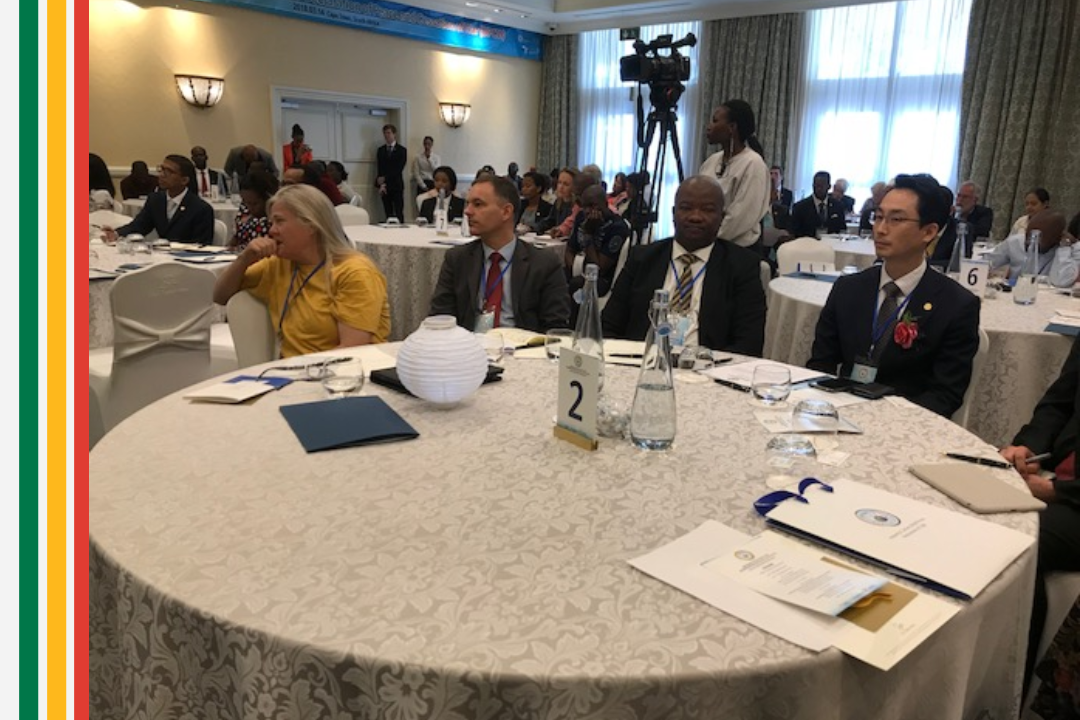
Admin
14 Mar, 2018
“The State of Peace in Africa – advancing the legal framework for a conflict-free Africa”
Bantu Holomisa, MP and UDM President’s contribution to the debate “The State of Peace in Africa” – advancing the legal framework for a conflict-free Africa” at the 2nd Annual Commemoration of the Proclamation of the Declaration of Peace and Cessation of War • Our hosts, • Colleagues, • Distinguished guests and participants, • Ladies and gentlemen 1. Introduction Let me start by saying that the United Democratic Movement (UDM) believes in the noble idea of the Declaration of Peace and Cessation of War (DPCW); especially in its uniqueness to end all war. Yet, as we are all aware, this is the proverbial “tall order”, which is ironic when one considers that most countries proclaim that peace is high on their national agendas. Let me also admit the following. In pondering this dilemma, and the virtuous intent of the DPCW, I am left with more questions than answers. 2. Religious persecution in Africa It is a sad fact that religious persecution is on the rise in Africa and the Middle East. It is said that the oppression of different religions in Africa dwarfs that of what is referred to as the world’s “most intractable conflict” i.e. the Israel/Palestine scenario. The world does not often enough talk about religious persecution in Africa, and the other “less important” parts of the world, as evidenced by President Donald Trump’s recent comment about Africa being a… I am not going to say the word. 3. Ethnic persecution in the name of religion To exacerbate matters, the line between ethnic and religious violence is often blurred. Differences in religion is used to “justify” ethnic cleansing or to assert dominance. The “us-and-them” mentality. Arguably the most stupefying example of this was the anti-Semitism in the Hitler-era. On a side note, with the acknowledgement of the suffering of Jews in Europe at that time, I wonder how those atrocities would compare to the religious persecution on the African continent over the last fifty years or so? However, in this regard, the DPCW is crafted broadly enough to say that war, no matter in which way it is justified, is wrong. Full-stop. 4. Religious persecution perpetrated by entire countries and how to make international law and concords stick? Naturally, to say that conflict in the name of religion, is only perpetuated by so-called radicals or fundamentalists, is simplistic. Persecution may be triggered by religious bigotry by a state when it views a particular religious group as a threat to its interests and/or security. Therein lies much of the rub for the DPCW. Even with internationally accepted definitions, many nations have a different interpretation of what constitutes “national interest” and “national security”. This is also not static, depending on which party, or dictator, governs a particular nation. There must be a universal agreement on what national interest, security and religious tolerance means; whether one talks about North Korea, Egypt, China or Nigeria. To use the analogy of alcoholism… admitting that there’s a serious problem is the first step. The next question would be, how does one treat countries where, at the most, they can be “punished” by using sanctions; which (more often than not), adversely affects the very people who needs protection from their governments. 5. Sovereignty of nations and their ability to defend themselves against aggressors Firstly, quite often the very countries where religious intolerance occurs, operate outside multi-national treaties and United Nations’ accords. One also has to be careful about the sovereignty of countries and even if this initiative gets billions of signatures to support it, how could this initiative, for example, stop China from considering the Dalai Lama a “dangerous separatist”. Secondly, as we have seen with the stand-off between North Korea and the United States, where does one draw the line between being able to defend one’s country against aggression versus demilitarising the entire world? Unfortunately (even though the world’s countries more or less have established boundaries) where humans are involved, conflict will ensue. That is why this initiative makes so much sense i.e. to have international understanding about achieving a warless society, that is legislated in some form. 6. Return of world-wide conservatism and refugees Terrorist attacks, sometimes in the name of religion, have contributed to an up-rise of world-wide conservatism, which has an element of intolerance. The issue of refugees, in the so-called developed countries, also contributes to this global “right swing”. It is clear that not enough is being done to resolve conflict in affected countries, especially in terms of our discussion today, on the African continent. 7. Conclusion The work of the United Nations, and international NGOs and bodies, is critical in bringing stability to many situations where religious persecution is rife; especially where it has escalated to war. The role of the media, as acknowledge in the DPCW, is an important piece of the puzzle, which is to shine a spotlight on the trouble-ridden parts of the world. However, the potentially biased interference by the world’s so-called super-powers, should be curbed. Even should their actions be well-intended, the world must understand that Africans will, because of our history, remain doubtful of our former colonisers. On a more positive note, the UDM has consistently advocated for constructive engagement between people with opposing views. Let the people with the problem, talk to each other (possibly with the assistance of a mediating body) or it should be considered to host a national gathering, where issues can be brought to the fore. In such a forum tolerance should be advocated and solutions found that suit all stakeholders; acknowledging and protecting religious (and other) minorities. Thank you Event hosted by: Heavenly Culture, World Peace, Restoration of Light in collaboration with the International Peace Youth Group and Junior Chambers International and Africa Unite
Admin
27 Feb, 2018
Subject for Discussion: Expropriation of land without compensation
Address by Mr ML Filtane, MP in the National Assembly Honourable Deputy-Speaker and Honourable Members In November 1990, 85 churches met for the National Conference of Church Leaders in South Africa and produced what is well known as the Rustenburg Declaration. The central theme of the Conference was the expression of the contrition for the wrongs and sins of the past, and a call for action to repair those wrongs. In paragraph 2.4. of the declaration, the (Church Leaders) Conference said … “we know that without genuine repentance and practical restitution we cannot appropriate God’s forgiveness and that without justice true reconciliation is impossible”. The Conference said… “As a first step towards restitution, we call on the Government to return all land expropriated … to its original owners”. The call by the church leaders, would respond to what, today, seems to be glaringly missing in the debate about land. Notwithstanding the provisions of the constitution, the question of moral demand or rightness of not only changing land access and relationships, BUT of repairing the hurt, misery, brokenness, and trauma of people often violently ripped from their land for generations. In 2013, we marked the centenary of the 1913 Native Land Act, which heralded an extraordinary scale of land dispossession. Many South Africans, including members of this House, made moving observations and experiences about the viciousness of that Act and its subsequent impact on land ownership in South Africa. However, any talk on land, has still not translated into a legislative and policy landscape that recognises the question of land reform as a matter inclusive economic development, moral concern and legal justice. The United Democratic Movement (UDM) supports the wide and inclusive consultative process on this matter of nation interest. We want to remind citizens that the most lucrative and substantial amount of land was taken before the 19th of June 1913. The failure of the restitution programme, as found in the report of the High Panel, represents justice denied. The principle of justice, as would have been understood by the conference of Church Leaders, demands that where something was unjust acquired or taken away, it must be returned or given back. In simple language, if you steal my vehicle, I lay a claim to it, I deserve it back. I am not required to buy it back. This is what the moral and legal interpretation of what justice must be. Justice delayed is justice denied. It cannot be that to the victor go the spoils and so a “finder-keepers” situation. In fact, what may invite unending conflict, is not the return of land to its rightful owners, but the refusal to do so “… return the land to its rightful owners”. Given the historical reality of our society, the current economic challenges confronting the nation, the increasing levels of inequality and poverty, the UDM support, the motion. Thank you
Admin
19 Feb, 2018
Subject for Discussion: DEBATE ON SONA
Address by Mr LB Gaehler, MP (NCOP) in the National Assembly Honourable Speaker and Honourable Members Mr President, we welcome your commitment to make the public service work. We therefore call on you, to professionalise service delivery as a function of public servants. They are employed to serve the people and not to be served by the people. Your administration, must put South Africa First. We must, as you have promised, make sure that public service is not a dumping site of unqualified, incompetent and lazy people, who are a product of your party’s deployment policy. This must come to an end now. Secondly, we welcome your commitment towards the Small Business Development. Accordingly, we suggest, that there must be consequences for failing to pay service providers within the specified time. There must be consequences for those who fail to implement government policy. For example, if a service provider is not paid within 30 days, there must be an interest accrued and such must be taken from the salary of the defaulting government official. As you establish your advisory streams, we call on you, to ensure that, this good initiative is not merely a payback for loyalty to you or your party. Therefore, you must, tap into the rich knowledge, expertise and wisdom of the society at large beyond party political confines. Mr President, industrialisation must not fly above the head of the majority of our people. It must originate and be driven from below. Your administration must invest in local economic development and prioritise rural economy. We are in this morass, as a consequence of poor management of state affairs by the governing party. However, you must be able to acknowledge this in order to steer the country on the correct course. It should be said that charity begins at home, cleansing must begin at home too. You must take the lead and deal decisively with those who commit crime against the people of South Africa. South Africans must be shifted from greed and corruption in which they have been accustomed to by previous leadership, and now focus on creating a society that we can all identify with and be proud to promote. If I judged correctly I would say approximately 80% of your speech was concentrated on economic matters and need for entrepreneurial revitalisation. We welcome your message of charting a new path for our country and imprinting footprints for what you call our future greatness. The idea of concentrating on JOBS, especially to tackle youth unemployment is well advised. I become concerned when politicians mention Extended Public Works jobs as part of tackling unemployment, as if they were sustainable jobs. These are dig a hole and fill it kind of jobs, they are great as emergency bailouts but are not real sustainable jobs. If we going to create real low skill jobs we must, as you have emphasized, you need to look deeper at construction and agriculture. We must couple it with the agenda of modernising our schools, building new community medical clinics that would expand access to quality low-cost care. We must include them on plans to upgrade broken-down electrical substations, localising the building of trains and buses and public housing to mention a few. The Job summit and investment conference are good ideas – provided it is not a white-wash in the manner in which government currently conducts its public consultations without effecting any suggestions from the public. You need to take seriously other people’s views, especially when they conflict with yours, because that is the only way you will also test and strengthen yours. Do not come with the dismissive attitude of thinking that the voice of experts on the field carries more weight. Often it is people on the ground, who know where it pinches and how to solve it. I am also sure opposition parties, like the UDM, who’ve been calling for an Economic Indaba will support you on this. Thank you