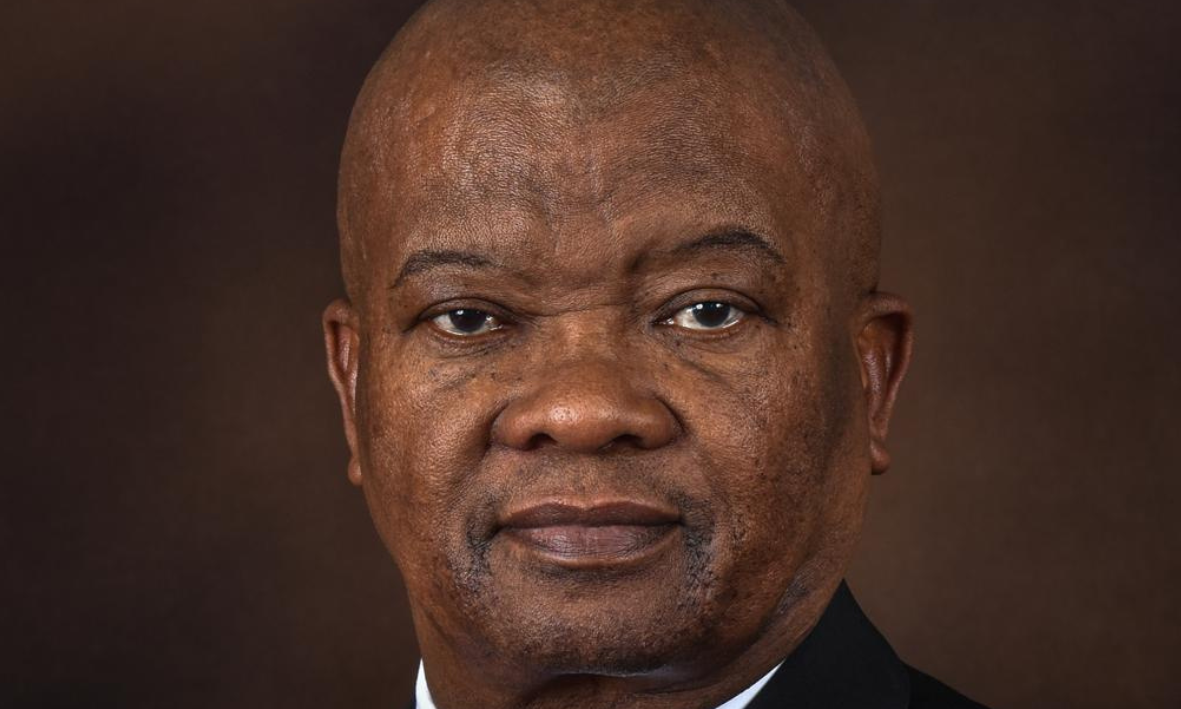
Speech by the President of the United Democratic Movement Maj. Gen. (Ret.) Bantu Holomisa, MP KwaTshezi Great Place
Traditional Leaders present here today,
Community elders,
Women and youth of KwaTshezi,
Leaders of civil society,
Councillors,
Fellow South Africans,
I am honoured to be here at KwaTshezi Great Place, near Coffee Bay, to engage directly with the people of this area.
Let me begin by expressing our sincere gratitude to the people of this great place. You are among those who made a conscious decision that South Africa should not become a one party state a chapter that belongs firmly in the past. That decision strengthened our democracy and reaffirmed the principle that leadership must always be accountable to the people. For that we thank you.
History has shown us that when power is concentrated for too long accountability weakens. Even law enforcement agencies have not been spared. When one reflects on the issues raised through the Madlanga Commission and the corruption exposed by General Mkhwanazi it becomes clear that under a one-party state some individuals, including General Mkhwanazi, would not still be occupying positions of authority today by virtue of being whistleblowers. This reality reinforces the urgency of ethical leadership.
Towards the end of 2025 at the Cabinet Lekgotla one of the key resolutions tabled dealt precisely with this crisis of accountability. President Cyril Ramaphosa openly expressed frustration and anger at the slow pace and lack of prosecutions in corruption related cases. He went as far as to state that ministers or directors general who fail to act or who serve as gatekeepers for criminals should pack and go. The doors are open for them to leave. That is what he said.
Another key resolution was the implementation of the Zondo Commission findings. I therefore anticipate that 2026 will be one of the years in which the Government of National Unity places strong emphasis on strengthening the criminal justice system. This will help restore confidence in the country’s leadership and enable decisive action on the triple challenges facing the nation. There can be no rebuilding of the country without consequences for wrongdoing.
During the same Lekgotla, high levels of crime, unemployment, and the challenge of illegal immigration were also discussed at length.
The reports of the Auditor General over the past thirty years tell a painful story. Announcements without implementing, findings without consequence management, and a culture of impunity across the board. Unfortunately this pattern has also engulfed the Department of Defence. People are aware of the pending criminal cases against the former Minister of Defence. This is part of what we inherited as a Government of National Unity, and we are confronting it directly.
Within the Department of Defence, the Hawks, the Auditor General of South Africa, the Special Investigating Unit, and the Military Police are now working together to restore integrity and clean the image of the department. I am proud to say that I have been part of coordinating this operation. The Auditor General has highlighted that there is improvement in addressing their queries.
Acting on a whistle blower report, I took steps to halt an irregular tender at Armscor in 2025. The Armscor Board subsequently cancelled that deal. We are currently following up on calls by Members of Parliament to investigate a contract in which Armscor allegedly awarded a tender for troop armoured plate carriers. This work is not easy. We are dealing with a culture that developed over nearly thirty years where the misuse of state resources became normalised.
The era of state capture embarrassed South Africa and severely damaged its institutions. By the end of the Government of National Unity term when, we hand over to the next government after 2029 election, we must be able to present a report that reflects a country in a far better state one that has decisively addressed the failures of the past three decades.
We saw early warning signs as far back as the 1996 Sarafina Two scandal and later, the 1998 Arms Deal. Auditor General reports on the South African National Defence Force point to lack of accountability weak consequence management and alleged corruption dating back as early as 2006. We do not have the luxury of time. We must deal decisively with corruption namasela without fear or favour.
The stolen money from departments, state owned entities, and parastatals has directly contributed to the collapse of infrastructure and the failure to improve services. It is the reason communities still lack proper roads, schools, clinics, fibre connectivity, police vehicles, and military equipment. Corruption is not an abstract crime. It is the reason people continue to suffer.
We therefore congratulate the recently appointed National Director of Public Prosecutions, Advocate Mothibi, and wish him well in his role. As a former head of the Special Investigating Unit, he has first hand knowledge of how corruption has damaged South Africa. We urge him to prioritise the backlog of cases within the Defence Force that have placed significant pressure on the National Prosecuting Authority.
In the same vein, I wish to commend the Special Investigating Unit for recovering over 1.6 billion lost within the Department of Defence, declared when they were briefing the portfolio committee on defence in a closed session. We look forward to working with the new head of the SIU and stand ready to cooperate fully with his team to restore integrity and accountability.
That is why the unfulfilled promises to this area are so painful. The people of KwaTshezi were promised water from the Mthatha Dam to Coffee Bay. Trenches were dug and later filled in again. No water came. Neither have there been action taken against the fingered officials of the OR Tambo District who allegedly squandered the funds for this project.
You were promised a proper road from the Viedgesville off ramp on the N2 to Coffee Bay. Former Minister Mbalula and SANRAL assured the community that a new road would be built, yet nothing materialised. Another route that has deteriorated severely is the turnoff from the Coffee Bay route that links it to Elliotdale. Its condition is now worse than it was in the past, to the point where sections are no longer usable. Today, these roads remain in a state of severe disrepair.
These roads lead to tourism centres where international resorts such as Coffee Bay and Hole in the Wall resorts are housed.
As residents of King Sabata Dalindyebo particularly here in Mqanduli we must now act collectively. There is a need for a formal approach led by traditional leaders, civil society, councillors, and community representatives to engage the national government directly.
This approach must not be a talk shop. It must demand clear commitments on roads infrastructure and development timelines. It must also summon network providers Vodacom, MTN, and Telkom to account for when rural connectivity especially in Mqanduli will be improved.
As we approach local government elections, we must also confront governance failures honestly. In line with what you have declared at the national level to get rid of one-party dominance, that must be reflected in the upcoming elections. Your vote can give way to concept of coalition governance to cascade to municipalities such as King Sabata Dalindyebo and OR Tambo District where long standing problems persist. Where systems fail communities, alternatives must be explored in the interests of the people.
Finally, the process that began in 2024 of sharing power among political parties has made it clear that after the 2029 elections, it will no longer be a foregone conclusion which party provides the President of South Africa. We must therefore remain vigilant and begin serious discussions about the kind of leadership required to take South Africa forward beyond this term.
The communities here must satisfy themselves that we will have leaders who would have passed the test of public scrutiny.
The people of KwaTshezi are not asking for miracles. They are asking for honesty accountability and action. That is a fair demand and one we must meet.
I thank you.