
Admin

10 Oct, 2025
Justice must prevail: UDM applauds flotilla mission and reaffirms support for ICJ process
Statement by Nqabayomzi Kwankwa, MP, UDM Deputy President and Leader in Parliament The United Democratic Movement (UDM) welcomes home the six South African activists who were detained after joining the Global Sumud Flotilla on its humanitarian mission to Gaza. The Party salutes Nkosi Mandla Mandela, Zukiswa Wanner, Carolyn Shelver, Zaheera Soomar, Dr Fatima Hendricks and Reaz Moola for their courage and solidarity with the people of Palestine. Their safe return to South African soil is a relief to their families and to all who value human rights and compassion. Yet their ordeal should trouble every conscience. The activists have spoken of terrifying experiences at the hands of Israeli forces. They described rifles being pointed at their heads, religious garments being torn off, humiliation, intimidation and degrading treatment. Dr Hendricks, a cancer survivor, recounted being stripped of her hijab and mocked by soldiers while in detention. These are not acts of security enforcement but violations of human dignity. The UDM condemns the abuse of humanitarian workers in the strongest possible terms. Those who deliver food, medicine and hope must never be treated as enemies. Their testimonies must be documented and investigated by international human rights bodies. The state of Israel must be held fully accountable for its actions and must respect international humanitarian law. This incident also comes at a time when the International Court of Justice (ICJ) is preparing to rule on Israel’s obligations in the occupied Palestinian territories. The world awaits this ruling with great anticipation. It was South Africa that brought this matter before the Court, arguing that Israel’s actions in Gaza and the West Bank amount to violations of the Genocide Convention and other fundamental principles of international law. In its earlier provisional orders, the ICJ directed Israel to prevent acts that could constitute genocide and to allow unimpeded humanitarian access. The forthcoming advisory opinion is therefore not an abstract legal exercise, but a continuation of a process initiated by South Africa in defence of international justice and human rights. Our country must continue to play a leading role in ensuring that these legal processes are respected and that the authority of the ICJ is upheld. This is both a legal duty and a moral obligation rooted in our own struggle for freedom, equality and dignity. The return of our compatriots should not mark the end of our concern but the strengthening of our resolve. Their courage reminds us that solidarity with the oppressed is not an act of charity but of justice. The UDM reaffirms that peace in the Middle East will only be achieved through justice and respect for human rights. The protection of civilians, the integrity of international law, and the equal dignity of all people must guide every nation’s actions.
Admin
03 Oct, 2025
Set humanitarian activists free; let aid reach Gaza
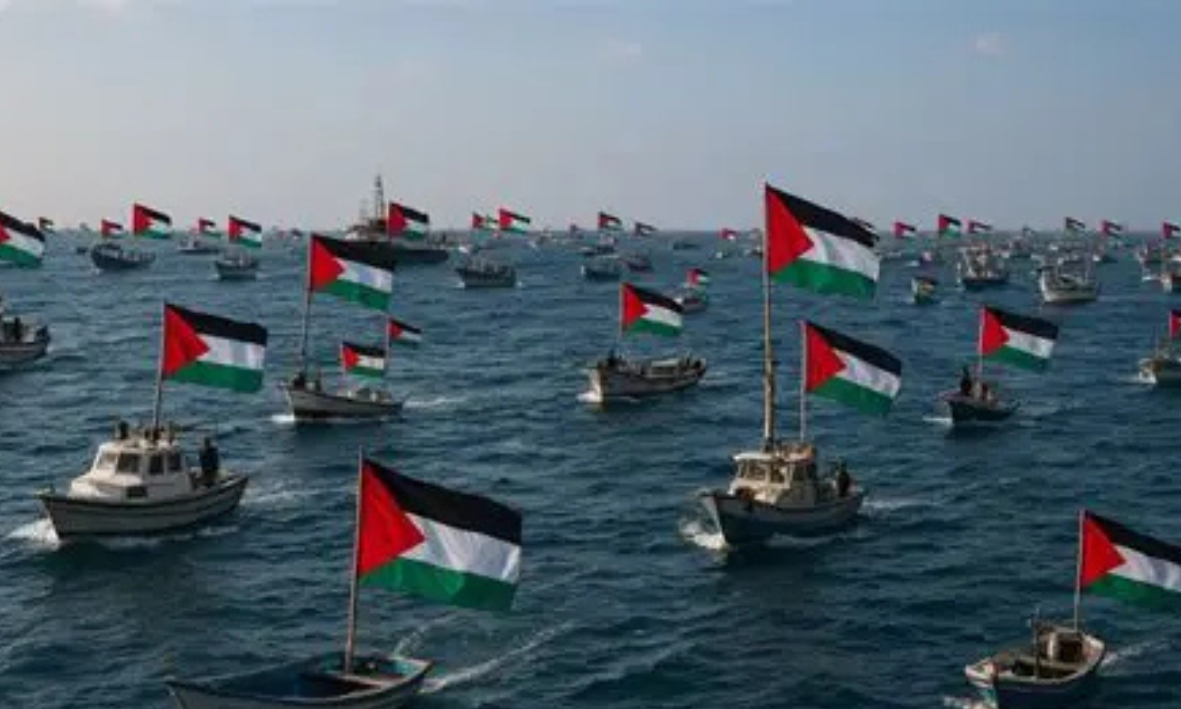
Statement by Nqabayomzi Kwankwa, MP, UDM Deputy President and Leader in Parliament The United Democratic Movement (UDM) joins the global outcry over the abduction of the Global Sumud Flotilla activists, including South Africans who were on a humanitarian mission to deliver aid and solidarity to the people of Gaza. We demand their immediate and unconditional release. These South Africans, alongside others from around the world, embarked on a mission of compassion. Their detention is not only a violation of their rights, but also an attack on the principle of humanitarian action itself. No one should be punished for carrying food, medicine, and hope to people in desperate need. The International Court of Justice ordered Israel to halt military operations in Rafah, to allow unimpeded humanitarian access, to prevent acts that could constitute genocide, and to preserve evidence of violations. Israel’s failure to comply with these binding measures defies international law, undermines the authority of the world’s highest court, and pushes the prospects of peace even further out of reach. The UDM has consistently called for peace in the Middle East. But peace cannot exist while humanitarian aid is blocked, and human rights are trampled underfoot. South Africa, given our own history of apartheid and liberation, has a moral responsibility to stand with the oppressed and to advocate for peaceful resolution. Our position is clear: the killing of civilians, the destruction of communities, and the obstruction of humanitarian aid are indefensible. The UDM reiterates its view that the long-term solution to this conflict lies not in violence or exclusion, but in inclusive dialogue and a just peace that upholds the rights and dignity of both Palestinians and Israelis. We reaffirm our support for Palestinian statehood and peaceful coexistence in the region. The abduction of humanitarian activists must be a wake-up call to the international community: inaction emboldens lawlessness.
Admin
01 Oct, 2013
Occupied Palestinian Territories hosted by Palestine Solidarity Campaign
A screening of ‘Occupation 101’ and panel discussion about the Occupied Palestinian Territories hosted by Palestine Solidarity Campaign Stellenbosch contribution by Mr Bantu Holomisa, MP (UDM President) at the University of Stellenbosch Facilitator, Fellow Member of Parliament, Mr Magama Palestine Solidarity Campaign Stellenbosch Academics and students Ladies and Gentlemen THANK YOU Thank you for the kind invitation to join you tonight, to listen and learn; and to discuss a complex issue that has been on the international agenda for many years i.e. the conflict between Palestine and Israel. MY UNDERSTANDING OF THIS COMPLEX ISSUE During the time of completing my matric at Jongilizwe College in 1975, we used to be given assignments by our teacher Advocate Dumisa Ntsebeza, who taught ‘current events’. One such assignment was the conflict in the Middle East. At that point in time, it was already clear that this particular conflict was micro-managed by the United States of America (USA) and that the rest of the world was not actively involved. Dr Henry Kissinger, the then USA Secretary of State, headed these so-called peace talks. There is broad consensus that the actions of the nations involved in the Arab-Israeli conflict violate limitations in international law. In studies conducted, psychologists have a number of terms for the tendency of humans to view their adversaries as springing from a lower order of being – these terms being pseudo-speciation or dehumanising. The conflict between these two groups have been compared to apartheid, but not apartheid as practiced in South Africa, but as apartheid as an international crime. We can compare the aforementioned conflict to apartheid, but the crucial issue is that the United Nations’ (UN) Security Council has failed to come to consensus for a resolution to this conflict as a result of the power given to certain countries. Implementation of the resolution could not be viable as a result of the veto by the USA. The International Convention of the Elimination of all forms of Racial Discrimination (1965) and other conventions may well give valid expressions on human rights.It does not give indications on how solutions can be implemented on a conflict that has been going on for such a long period. One can ask oneself: how strong does international law stand against organised religion? We see how organised religion has Muslims and Jews denying their common humanity. Thus confirming that the conflict is now out of the hands of the people of the Middle East. The conflict will not be resolved until the UN Security Council is transformed. Human rights and all that it comes with it, is vital for any people. It is a sensitive issue. As long as there is no united consensus on the resolution of this conflict, we would be held accountable for contributing to creating a generation that will be called “fundamentalist” and “extremist”. This conflict now, because of America’s interest in the Middle East, has hardened attitudes of the many countries in the Middle East, where they are accusing America of arming and funding Israel against Palestine and being a threat to neighbouring countries. The USA on the other hand has been accusing countries like Iran and Syria of helping Palestine militarily. SOLUTION It is clear that the use of force is not going to help anybody; it has been tried without success. It looks like this conflict can only be solved peacefully The question is how? Who should sponsor the peace? Perhaps this conflict should be a package to the reported warming up of the relationship between President Obama and the President of Iran as well as the flexing of muscle by Russia on the Syrian Debacle. This could be the start of things to come, on finding a lasting solution between Israel and Palestine. I thank you.