Bantu Holomisa Keynote address at 6th National Congress
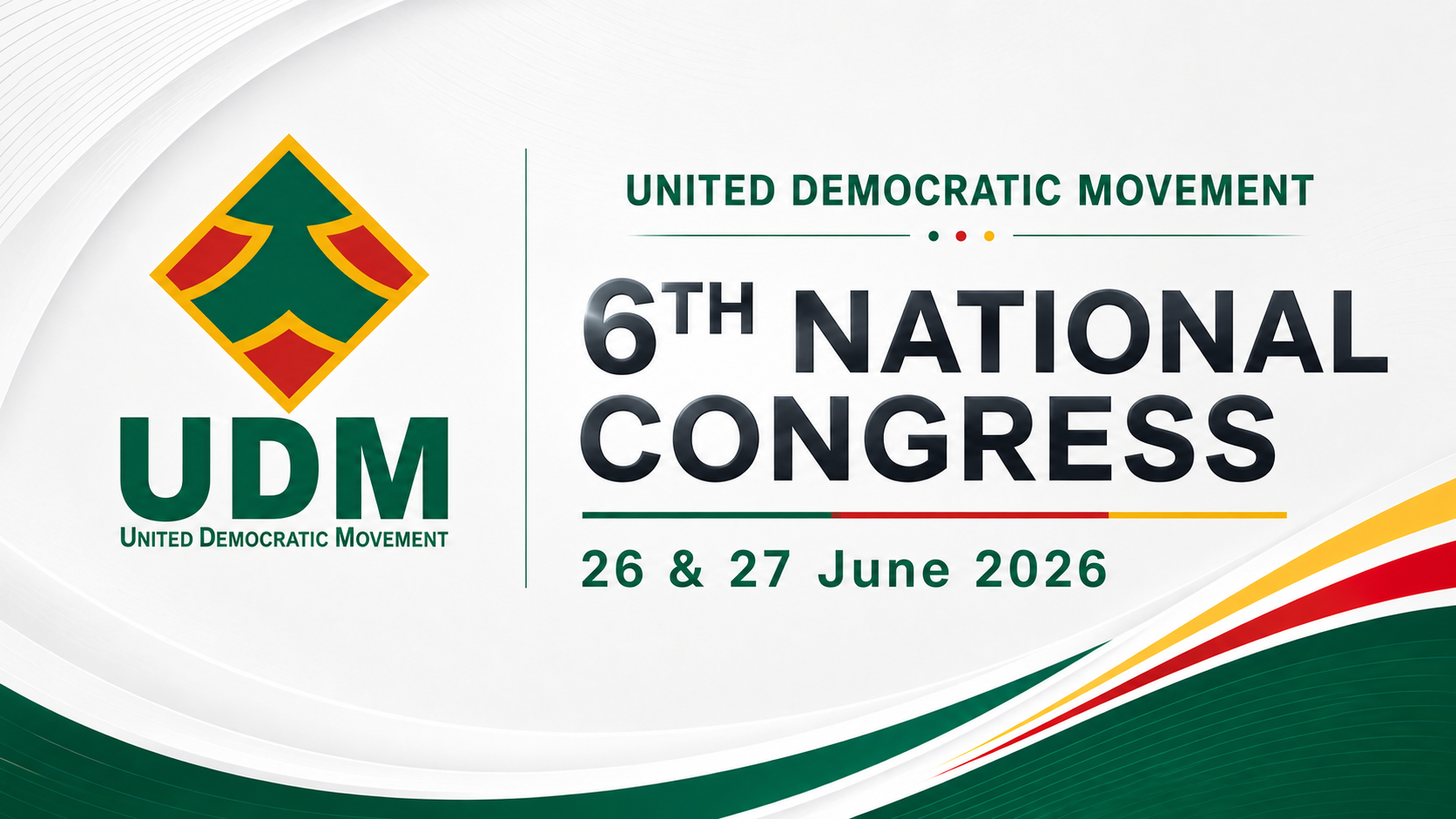
Keynote Address by Maj. Gen. (Ret.) Bantu Holomisa, MP, President of the United Democratic Movement at the 6th National Congress and Launch of the 2026 Local Government Elections Manifesto - Absa Stadium, East London on 27 June 2026
• Deputy President of the UDM, Nqabayomzi Kwankwa;
• Members of the National Executive Committee;
• Provincial and Regional Leadership;
• Delegates of the Sixth National Congress;
• Representatives of civil society, traditional leaders, religious formations and organised labour;
• Invited guests;
• Members of the media;
• Fellow South Africans;
• Comrades and friends,
1. Introduction
Allow me first to express my sincere gratitude to the delegates of the United Democratic Movement (UDM), our members throughout the country, our supporters, and the general public who have sustained this organisation with their resources, commitment and sacrifices over many years.
The UDM did not arrive here because we had the biggest budget. We did not arrive here because we enjoyed access to state resources.
We arrived here because ordinary South Africans believed in the values upon which this movement was founded and continued to support us even during the most difficult times.
There were those who wrote our political obituary from the very beginning.
There were those who predicted that the UDM would disappear after one election, after one leadership contest, after one political challenge or another.
Yet here we are today, convening our Sixth National Congress and preparing to celebrate thirty years of existence in September 2027.
The fact that we are still here is not an accident.
For all this, we extend our appreciation to the National Office Bearers and staff for organising this National Congress, notwithstanding all the challenges we encountered.
We also appreciate the volunteers, staff, ABSA Stadium Management, and service providers who have worked tirelessly behind the scenes to ensure that this gathering is a success.
Your contribution is noted and valued.
Anyone who has followed the history of the UDM and cared to read about our journey will know that our strength has always been our consistency.
• Consistency in our messaging.
• Consistency in our values.
• Consistency in our presence amongst the people.
• Consistency in making ourselves available and accountable to South Africans regardless of whether there was an election around the corner or not.
We are one party that should be proud of its contribution to South Africa's democracy and proud of the victories we have achieved over the years.
It was the UDM that consistently promoted the ethics of good governance long before it became fashionable to speak about corruption.
It was the UDM that campaigned relentlessly against floor crossing until it was removed from our statute books.
It was the UDM that fought for legislation regulating political party funding.
It was the UDM that secured a landmark Constitutional Court victory on the secret ballot matter.
Against all odds, it was the UDM that exposed the misuse of workers' pension funds through the Government Employees Pension Fund and the Public Investment Corporation, and many other ongoing battles.
These were not popular battles. They were not easy battles. Yet they were necessary battles because they were in the interests of the people of South Africa.
The UDM has never confined itself to parliamentary debates and press statements.
When disaster struck our people, we were there.
During the 2025 floods and disasters in the Eastern Cape, we were on the ground assisting affected communities in Mthatha, Butterworth and surrounding areas where 95 lives were tragically lost.
While others were counting statistics, we were helping communities.
While others were compiling reports, we were delivering practical assistance.
In KwaTshezi near Coffee Bay, we assisted in constructing a bridge that has restored access to Zithulele Hospital and enabled communities to cross safely.
To this day, communities continue to wait for permanent intervention from government despite countless promises and assessments.
That is the difference between politics as a profession and politics as a calling.
The UDM has always believed that leadership requires action.
Betting on a wicket of anti-corruption was once regarded as political suicide.
It contributed to my own departure from the African National Congress (ANC) because many people did not want to hear uncomfortable truths.
Today it is gratifying to see that, what was once dismissed has now been confirmed repeatedly through official investigations and commissions.
Those who did not understand the campaign against corruption at the time eventually came forward and reported corrupt activities.
Those reports led to the findings of former Public Protector, Advocate Thuli Madonsela.
They led to the State Capture Commission.
They led to the UDM-sponsored Mpati Commission.
They led to the current Madlanga Commission which has taken the nation by storm.
It is evident, without a shed of doubt, that corruption has spread its tentacles to state institutions, including the Department of Defence where I serve as Deputy Minister as you have witnessed.
Today various allegations and investigations involving senior law enforcement structures continue to reinforce concerns that many of us raised years ago.
South Africans have reached their own conclusions.
That is why in 2024 voters made a historic decision.
They decided that South Africa should no longer be governed through the dominance of a single political party.
They opted for a coalition arrangement.
They effectively instructed political parties to work together.
That is why we now have a Government of National Unity.
The voters were saying that political parties must work together to address corruption, unemployment, crime and poor governance.
By the look of things, coalition politics are here to stay.
We must develop a political culture where coalition governments are stable, accountable and focused on service delivery.
At national, provincial and local level, coalition governance must be refined because it is increasingly becoming the future of governance in South Africa.
Fellow delegates,
I am addressing you today at a time where serious questions are being raised about the activities of some Members of the Executive.
For instance, many people will ask you, the members of the UDM what happened to the case of former Minister of Defence who was charged for corruption and many other high-profile individuals.
The public will further ask you what our position is regarding the impeachment process involving the President, where the Constitutional Court brought the matter back to Parliament for further processing.
Our position remains unchanged.
The UDM supports the establishment of the Section 89 Impeachment Committee and believes that Constitutional processes must be allowed to run their course.
There has been no shift from what we said during the debate on the report of the Independent Panel chaired by Judge Sandile Ngcobo.
We maintain that the President, together with all those implicated in the matter, must make use of the opportunity to present their side of the story before the committee.
The purpose of the process is to establish the facts, uphold accountability and strengthen our Constitutional democracy.
As the UDM, we have always maintained that no individual is above accountability and that Constitutional mechanisms must be respected and allowed to function without fear or favour.
Fellow delegates,
Once this Congress has elected its leadership, our focus must immediately shift to the 2026 Local Government Elections and the road to 2029.
We expect to come out of this National Congress with a dynamic leadership team that reflects a balance between experienced leaders and young people, who will together drive the growth, renewal and strengthening of the party going forward.
The new leadership, because of the evident growth of the UDM, will have to hit the ground running by improving coordination and communication within the structures.
They must also strive to promote unity, and to see it that the UDM reaches all the corners of South Africa.
We have consistently argued that South Africa has entered a new political era. The days of one-party dominance are behind us.
The responsibility of the UDM is not merely to participate in this reality, but to shape it.
Our structures must emerge from this Congress united, focused and ready for the task ahead.
It is going to be important to nominate Councillors who will understand the role they are to play in municipalities in service of our people.
Equally, we must strive to depoliticise the government administration.
Every branch, region and province must work towards growing the UDM so that it has a stronger voice in the Government of National Unity and a bigger presence in Parliament after 2029.
No party can say with certainty who will provide leadership to South Africa after President Cyril Ramaphosa has finished his term.
The political landscape is changing, and the UDM must position itself to play a far greater role in influencing the future of our country.
Our mission remains unchanged.
We must continue to champion ethics, good governance and accountability.
There is no one in this country who can doubt the role we are playing in that front.
The UDM must be at the forefront of ensuring that those implicated in corruption are charged, that adverse findings by the Auditor-General (AGSA) are acted upon, and that public institutions serve the people rather than politicians.
Too often AGSA reports expose the same failures year after year, yet little is done.
That culture of impunity must come to an end.
As we grow, we must remain clear about the type of partnerships we are prepared to enter.
We must work with parties that serve the people, not those that seek to protect politicians caught with their fingers in the till.
Our loyalty must always be to the people of South Africa.
Mawubuye uMzantsi Afrika esiwuthandayo emaseleni, mawubuye!
The evidence emerging from inquiries such as the Madlanga Commission, the collapse of state-owned enterprises, and the corruption repeatedly exposed in the media all point to the same problem: years of ignored warnings, ignored Auditor-General findings and a lack of consequence management.
The UDM must continue to be the voice that asks difficult questions, demands accountability and fights for clean governance.
That is the role we have played for nearly three decades, and it is the role we must play with even greater determination as we build towards 2026 and 2029.
2. The challenges confronting South Africa
Fellow South Africans,
As we gather here today, South Africa continues to face serious challenges.
At the forefront are unemployment, crime, porous borders, weak immigration systems, unemployment, a stagnant economy and corruption.
These challenges continue to undermine confidence in our democracy and deny millions of South Africans opportunities to improve their lives.
We must also have an honest discussion about immigration management and national security.
The Deputy President of the UDM, the Nqabayomzi Kwankwa, has already outlined the position of the UDM in Parliament, and he was both eloquent and unambiguous in doing so.
My role here is simply to add further context and depth to that position.
Many of the immigration problems we face today did not arise by accident.
There were individuals and networks who positioned themselves to benefit from a weak immigration system and porous borders.
South Africans will recall the history of Dyambu Holdings, a company established through ANC Women's League structures and was awarded an exclusive contract relating to the detention and deportation of illegal immigrants through Lindela.
That company was later acquired by BOSASA, whose role in the looting of state resources has been extensively documented.
The lines between political influence, government contracts and private enrichment became increasingly blurred.
When South Africans ask how we arrived at a situation where Home Affairs is under such pressure, where border management has been compromised and where questions are being asked about the integrity of documentation systems, they are entitled to examine this history fully.
The state's failure over many years to exercise effective control over its borders did not only create governance challenges; it also created opportunities for those who sought to profit from dysfunction.
It is difficult to escape the conclusion that some people saw immigration management not as a national security responsibility, but as a business opportunity, hence we find ourselves sitting with porous borders.
For many years South Africa did not maintain an appropriate balance between social expenditure and investment in national security institutions.
While enormous resources were directed towards social support programmes, many strategic institutions responsible for securing the country gradually experienced declining capacity.
The consequences are now visible.
o Border management challenges have increased.
o Criminal syndicates have exploited weaknesses in the system.
o Drug trafficking networks have become more sophisticated.
o Human trafficking syndicates continue to operate.
o Counterfeit goods continue to enter the country.
Communities are increasingly concerned about illegal migration, undocumented persons and the impact these challenges have on public services, employment opportunities and community safety.
These concerns are not new.
South Africans have been raising these issues for years.
Unfortunately, many of these concerns were ignored until they reached crisis proportions.
Today government is spending millions combating drug syndicates, tracing undocumented persons and addressing problems that should have been confronted much earlier.
What South Africans want now is not arguments about who raised these concerns first.
They want solutions.
The security cluster must therefore become a national priority.
The lesson for us today is simple. We must fix the system.
We must strengthen border management, restore integrity at Home Affairs, eliminate corruption wherever it exists, and ensure that immigration policy serves the interests of the country and the rule of law.
This is not about hostility towards anyone.
It is about ensuring that South Africa has an immigration system that is lawful, fair, efficient and properly administered.
If, as is now being alleged through investigations by the SIU, there were officials within Home Affairs who fraudulently issued identity documents, permits and other official records, then South Africans deserve answers.
We need to know which documents were issued lawfully and which were obtained through fraud and corruption.
We need to know who benefited, who authorised it, and what corrective measures will be taken.
South Africans have a right to confidence in the integrity of the country's documentation systems. Restoring that confidence must be a national priority.
Home Affairs, Department of International Relations and Cooperation (DIRCO), South African Police Service (SAPS), State Security and Defence must intensify their working relations to stabilise the situation.
We may have to engage the African Union and the United Nations and ask for understanding and patience as South Africa undertakes the difficult task of restoring order to systems that have been neglected for many years.
As a result of this neglect, South Africa is still fighting grey listings from international rating agencies, a phenomenon that continues to affect the lives of many South Africans daily.
One of the major concerns highlighted by these agencies is the high level of corruption, South Africa's suspected use as a conduit for illicit activities, the prevalence of money laundering, weaknesses in visa and immigration processes, and a range of other governance and security-related challenges.
In the same vein, we may need to strengthen dialogue with the Southern African Development Community (SADC) region to ensure a coordinated and cooperative approach to migration management, including joint frameworks and mechanisms to address cross-border movement in a structured and lawful manner.
The government of South Africa, together with civil society and other stakeholders, should seriously consider a temporary moratorium of between six and twelve months to clean up an immigration system that has been plagued by challenges for decades.
During this period, district-level immigration verification committees, chaired by district magistrates and comprising members of the security cluster and relevant government departments, should be established to determine who is in the country, under what status, and whether the documentation they possess is valid.
Given the allegations of fraud and corruption that continue to emerge, South Africa can no longer rely solely on existing Home Affairs databases without verification.
These committees should establish clear timeframes for permit holders and other documented foreign nationals to verify the authenticity of their documentation, with a view to identifying and removing fraudulent records from the system.
This exercise must be lawful, fair and non-discriminatory. It must have no colour, no nationality and no political agenda.
Those who are lawfully in South Africa should have nothing to fear; the objective is simply to restore integrity to the system and ensure that the rule of law prevails.
When South Africa calls for the implementation of its laws, particularly on matters relating to illegal immigration, that should not automatically be interpreted as xenophobia.
Every sovereign state has a responsibility to uphold its laws and protect its national interests.
We ask for understanding from those who are quick to label South Africans when legitimate concerns are raised.
South Africa requires breathing space to address challenges that have accumulated over decades.
National security must remain a priority.
At the same time, we call upon all migrants who are legally in South Africa to cooperate with authorities as government undertakes the necessary work of restoring integrity to the system.
We remain a peaceful nation.
We remain committed to human dignity.
But we must also restore confidence in the rule of law.
3. What has gone wrong in our municipalities?
Fellow South Africans,
Wherever one travels in South Africa today, whether in villages, townships, suburbs, informal settlements or rural communities, the signs of municipal decline are impossible to ignore.
People are living with dry taps while billions are allocated for water infrastructure.
Sewage flows through streets and into rivers while municipalities speak of plans and strategies.
Roads remain unrepaired for years while communities are told to be patient.
Streetlights do not work. Refuse remains uncollected.
Parks and public facilities are neglected.
Billing systems are broken. Municipal debt continues to grow while service delivery continues to decline.
The people of South Africa are asking a simple question: where is the money going?
The truth is that municipalities have not failed because communities are impossible to serve.
They have failed because the basic principles of governance have been abandoned.
Too many municipalities have become centres of patronage rather than centres of service delivery.
Political loyalty has been rewarded ahead of competence.
Public funds have been diverted away from the needs of communities.
Infrastructure has been neglected until it collapses completely.
Audit findings have been ignored.
Corruption has gone unpunished.
Councillors have disappeared from communities and resurfaced only when elections approach.
The result is that ordinary residents are paying more and receiving less.
Businesses are struggling to survive because municipalities cannot provide reliable services.
Young people are trapped in communities where there are few opportunities and little economic activity.
Poor households are expected to pay for services that often do not work.
This is not what local government was intended to be.
Municipalities exist to serve communities.
They exist to maintain infrastructure, provide services, create conditions for economic growth, protect public resources and improve the quality of life of residents.
The UDM therefore says enough is enough.
Local government must return to its core purpose.
That is why today we are launching a manifesto that is practical, realistic and rooted in the daily experiences of South Africans.
4. The UDM's 12 pillars for local government that works
Our manifesto is built around twelve pillars that together provide a comprehensive programme for rebuilding municipalities and restoring public confidence in local government.
1) The first pillar is Reliable Basic Services and Maintenance because no municipality can succeed if residents do not have reliable access to water, sanitation, electricity, roads, refuse removal and functioning public infrastructure.
2) The second pillar is Clean Governance and Financial Discipline because corruption, maladministration and wasteful expenditure are stealing resources that should be improving the lives of our people.
3) The third pillar is Fair Tariffs, Responsible Revenue and Protection of Indigent Households because municipalities must collect revenue fairly while protecting vulnerable households and ensuring residents receive value for money.
4) The fourth pillar is Local Economic Development, Opportunity and Dignity because municipalities must become engines of growth that support small businesses, cooperatives, informal traders, township enterprises and local job creation.
5) The fifth pillar is Housing, Land Use and Integrated Human Settlements because people deserve housing developments that are planned properly, connected to services and linked to economic opportunity.
6) The sixth pillar is Rural Revitalisation and Urban Renewal because rural villages, townships, towns and cities face different challenges and require targeted interventions.
7) The seventh pillar is Safe, Liveable and Climate-Resilient Communities because communities cannot thrive in environments characterised by crime, neglect, environmental degradation and poor disaster preparedness.
8) The eighth pillar is Public Health, Clean Communities and Environmental Health because clean water, functioning sanitation, refuse removal and environmental management are fundamental to human dignity.
9) The ninth pillar is Youth, Sport, Culture and Social Development because young people deserve opportunities to develop their talents, access facilities and participate in community life.
10) The tenth pillar is Participatory Democracy and Accountable Councillors because communities must be partners in governance and councillors must remain visible, accessible and accountable.
11) The eleventh pillar is Traditional Leaders and Community Governance because development works best when municipalities and traditional leadership structures cooperate in the interests of communities.
12) The twelfth pillar is Responsible Coalitions and Cooperative Governance because coalition politics is now a reality in South Africa and must be guided by principles, stability and service delivery rather than political opportunism.
These are not theoretical pillars. They are practical commitments designed to address the daily realities faced by South Africans.
5. The UDM's approach to local government
Underlying these twelve pillars are six simple principles.
1) Basic services must be reliable.
2) Public money must be protected.
3) Councillors and officials must be accountable.
4) Communities must be treated as partners.
5) Municipalities must be stable, ethical and capable.
6) Councillors must provide oversight and must never interfere in procurement or administration.
This last principle deserves special emphasis.
One of the greatest contributors to municipal collapse has been the blurring of lines between politics and administration.
A councillor is not a municipal manager.
A councillor is not a procurement officer.
A councillor is not a tender adjudicator.
The role of councillors is to represent communities, monitor implementation, exercise oversight and ensure accountability.
The role of administrators is to manage municipal affairs professionally and in accordance with the law.
Once politicians begin deciding who gets contracts, who gets appointed and who benefits from municipal resources, service delivery becomes secondary and communities suffer.
The UDM will defend the professionalisation of local government because competent municipalities deliver services and incompetent municipalities create crises.
The details of this manifesto are in the conference packs which we have distributed.
Those who wish to read this manifesto may alternatively make use of our website, www.udm.org.za and this information first-hand.
6. What this election is really about
The 2026 Local Government Elections are not about politicians.
They are not about positions.
They are not about political slogans.
They are about daily life.
They are about whether water comes out of the tap.
Whether refuse is collected.
Whether roads are maintained.
Whether communities are safe.
Whether public money is protected.
Whether councillors are visible.
Whether young people can find opportunities.
Whether municipalities work.
The UDM does not promise miracles.
We promise ethical leadership.
We promise accountability.
We promise practical solutions.
We promise to place communities before politics.
Our message is clear.
South Africa has had enough of excuses.
It is time for municipalities that work.
It is time for competent administration.
It is time for clean governance.
It is time for councillors who serve the people.
It is time for local government that is consistent in-service delivery, present in communities and accountable to residents.
That is the UDM offer.
That is the UDM manifesto.
7. A call to the people of South Africa
As we conclude this National Congress and launch our 2026 Local Government Elections Manifesto, we make a clear appeal to the people of South Africa.
We ask you to judge us not by words, but by our work.
We ask you to judge us not by promises, but by delivery.
We ask you to judge us not by political rhetoric, but by our presence in your communities.
We are ready to restore dignity to local government.
We are ready to rebuild municipalities that work for the people.
From Khayelitsha to Phuthaditjhaba,
Let us move forward together.
Let us build stronger communities.
Let us restore trust in governance.
Let us renew hope in our democracy.
And let us ensure that local government becomes once again what it was meant to be: a system of service, dignity and development for all.
Phantsi ngamasela Phatsi!
Phantsi ngo hlohlesakhe Phantsi!
Phambili nge nkonzo Phambili!
Phambili ngesikhokhelo esithembekileyo Phambili!
I thank you.